Brainstem

Brainstem

Anatomy · 19 cards

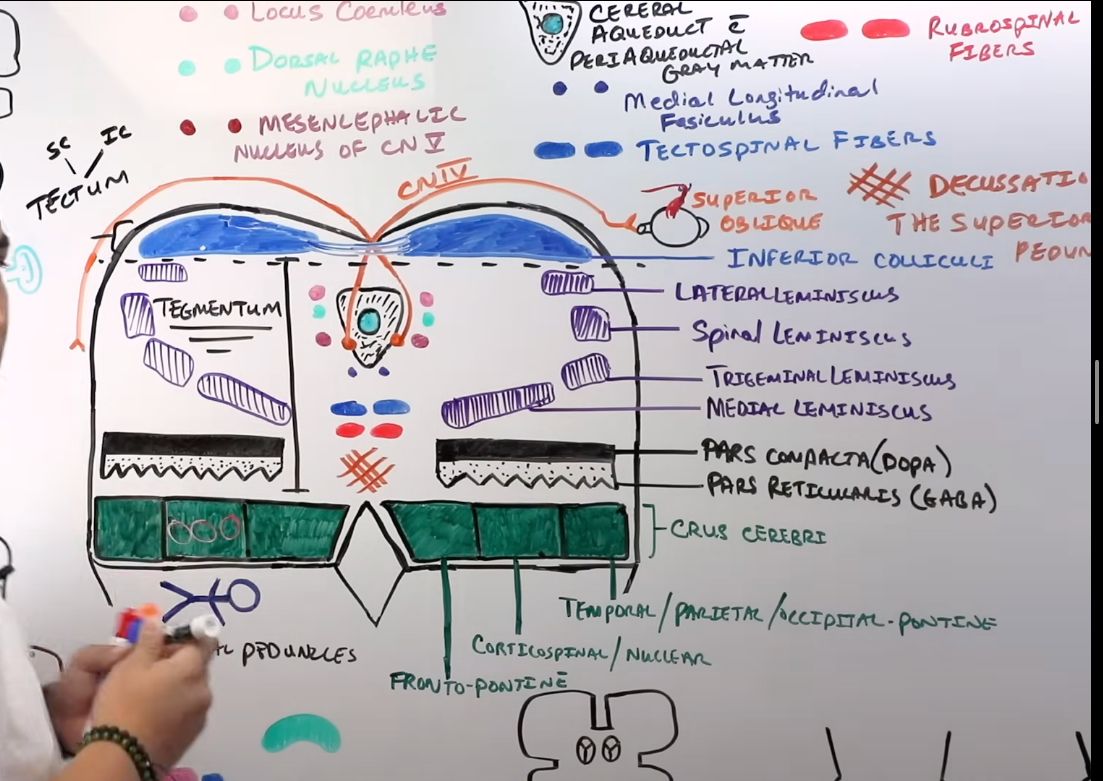
Midbrain Superior Colliculus :: Overall Layout and Ventral Structures

This cross-section is at the level of the superior colliculus[…]. From ventral to dorsal: crus cerebri → substantia nigra → tegmentum → tectum[…].

Crus cerebri has three bands: the medial[…] band carries corticopontine (frontopontine) fibers from frontal lobe; the middle band carries corticospinal and corticobulbar[…] tracts; the lateral[…] band carries parieto-/temporo-/occipito-pontine fibers.

The substantia nigra[…] sits dorsal to the crus as a dark stripe: pars compacta contains dopamine[…] neurons; pars reticulata contains GABA[…] neurons.
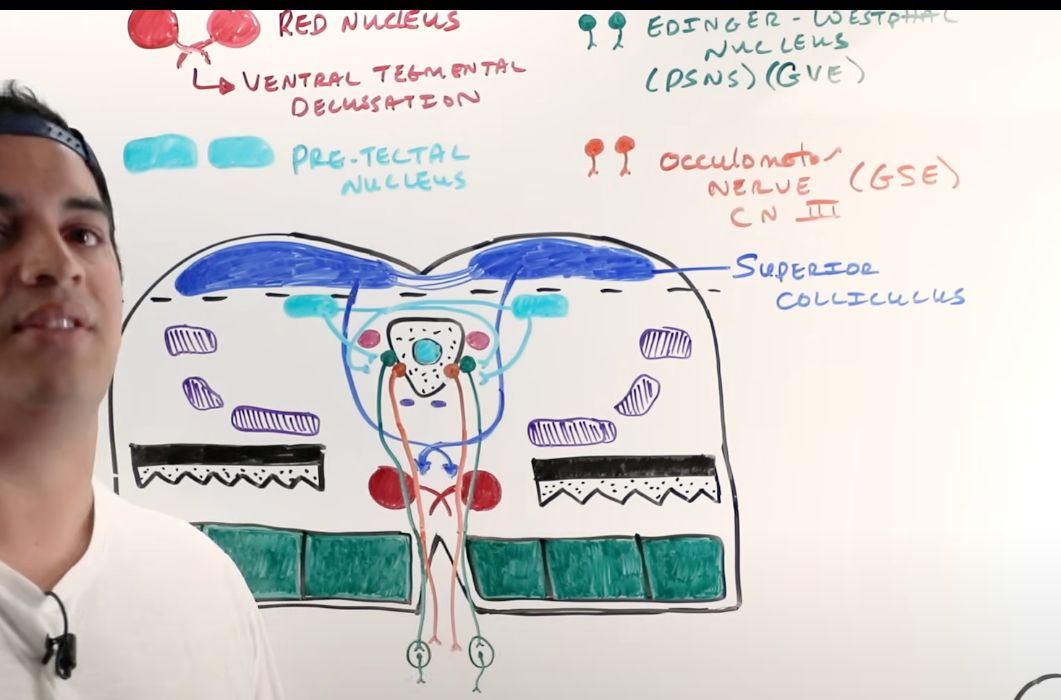
Midbrain Superior Colliculus :: Lemnisci and Tegmentum

  • Three lemnisci traverse this level: the medial[…] lemniscus carries DCML; the trigeminal[…] lemniscus carries face sensation; the spinal[…] lemniscus carries the spinothalamic (STT) pathway.
  • The periaqueductal gray (PAG)[…] surrounds the cerebral aqueduct, which connects the 3rd[…] ventricle to the 4th[…] ventricle.
  • The red[…] nucleus sits in the midbrain tegmentum, with the ventral tegmental decussation[…] carrying crossing rubrospinal fibers.
Midbrain Superior Colliculus :: Pretectal and Oculomotor Nuclei

The pretectal[…] nucleus drives the light reflex, sending bilateral output to both Edinger-Westphal[…] nuclei (explaining the consensual response).

The oculomotor[…] nucleus (CN III) is present at this level; the Edinger-Westphal nucleus provides parasympathetic[…] fibers for pupil constriction and accommodation.

The MLF[…] links vestibular nuclei to CN III, IV, and VI.

The tectum[…] forms the roof of the midbrain; superior colliculus fibers cross in the dorsal tegmental decussation[…] as the tectospinal tract.
Midbrain Inferior Colliculus :: Ventral and Lemnisci

At this level, crus cerebri + tegmentum together form the cerebral peduncles[…].

Crus cerebri organization mirrors the SC level: medial = corticopontine[…] from frontal; middle = CST/CBT[…]; lateral = parieto/temporo/occipito-pontine.

The substantia nigra has dopaminergic pars compacta[…] and GABAergic pars reticulata[…].

Four lemnisci run here: medial (DCML[…]), trigeminal (face sensation), spinal (spinothalamic[…]), and the lateral[…] lemniscus (auditory, newly entering at this lower level).
Midbrain Inferior Colliculus :: Dorsal Nuclei and Tectum

The locus ceruleus[…] provides norepinephrine; the dorsal raphe[…] nucleus is serotonergic.

The mesencephalic nucleus of CN V[…] (proprioception from muscles of mastication) connects into the trigeminal lemniscus.

The trochlear (CN IV)[…] nucleus controls the superior oblique muscle.

The tectum at this level contains the inferior colliculus[…], essential for auditory reflexes and sound localization.

Descending tracts: MLF[…], tectospinal[…] (colliculi to neck/eye), and rubrospinal[…] (from red nucleus). The superior cerebellar peduncle decussates at this level.
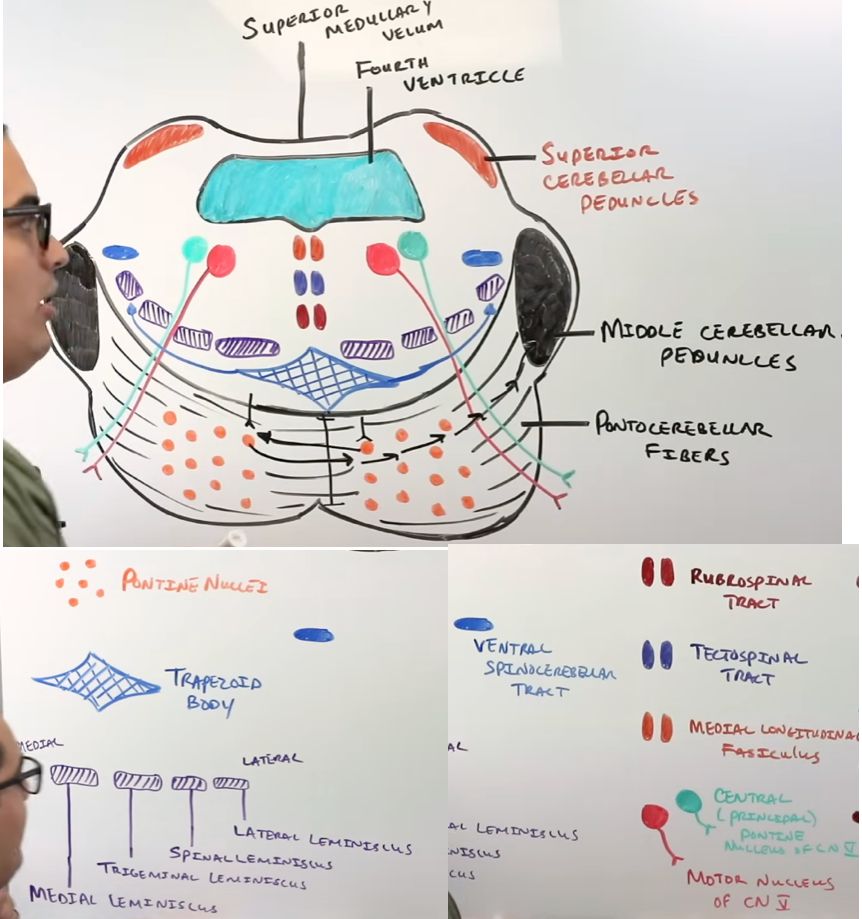
Pons CN5 Level :: Ventral and Trapezoid Body

The base of the pons contains the pontine nuclei[…]. Corticopontine fibers synapse here, then decussate[…] to the opposite side as ponto-cerebellar axons traveling to the contralateral middle cerebellar peduncle[…].

The trapezoid body[…] carries crossing auditory fibers from the cochlear nuclei.

Four lemnisci run here: medial (DCML), trigeminal (face)[…], spinal (STT), and lateral (auditory)[…].
Pons CN5 Level :: Trigeminal and Tegmental Tracts

The trigeminal motor nucleus[…] controls muscles of mastication; the principal (chief) sensory pontine nucleus[…] of CN V is at this level, processing discriminative touch and proprioception from the face.

Tegmental tracts: rubrospinal[…] from red nucleus, tectospinal[…] from colliculi, and the MLF[…] linking vestibular nuclei to CN III/IV/VI.

Dorsally, this level borders the 4th ventricle[…], with the superior medullary vellum forming part of its roof. A small portion of the superior cerebellar peduncle[…] is visible (most lies in midbrain).
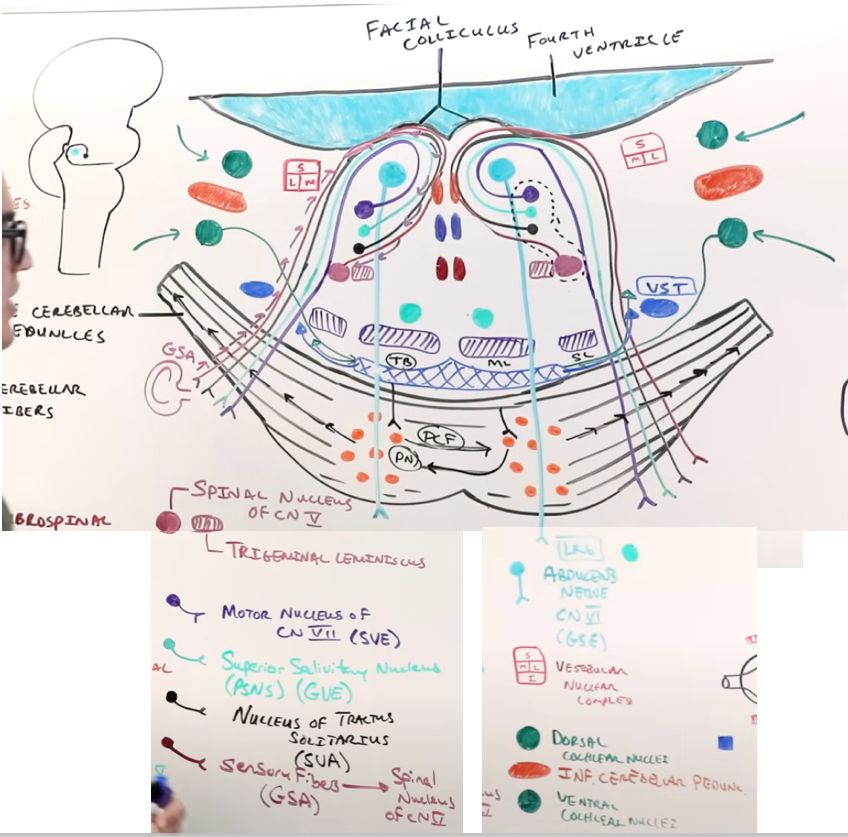
Pons CN6/7 Level :: Ventral and Lemnisci

The base of the pons contains the pontine nuclei[…]; corticopontine fibers synapse and decussate as ponto-cerebellar axons to the contralateral middle cerebellar peduncle.

The trapezoid body[…] carries crossing auditory fibers.

Three lemnisci pass here: medial (DCML[…]), trigeminal (face), and spinal (spinothalamic[…]). The ventral spinocerebellar[…] tract also runs in this section.

The superior olivary nucleus[…] helps process auditory input.
Pons CN6/7 Level :: Cranial Nerve Nuclei

The spinal nucleus of CN V[…] lies with the trigeminal lemniscus.

The CN VII bundle includes the facial motor nucleus[…] (branchial motor to facial expression), superior salivatory nucleus[…] (parasympathetic to lacrimal/submandibular/sublingual glands), spinal nucleus of CN V (special sensory), and nucleus tractus solitarius[…] (taste from anterior 2/3 tongue).

The abducens (CN VI)[…] nucleus controls lateral rectus.

The vestibular nuclear complex has superior, medial, and lateral[…] nuclei here.

Dorsolaterally: ventral and dorsal cochlear[…] nuclei; a small piece of the inferior cerebellar peduncle is visible.
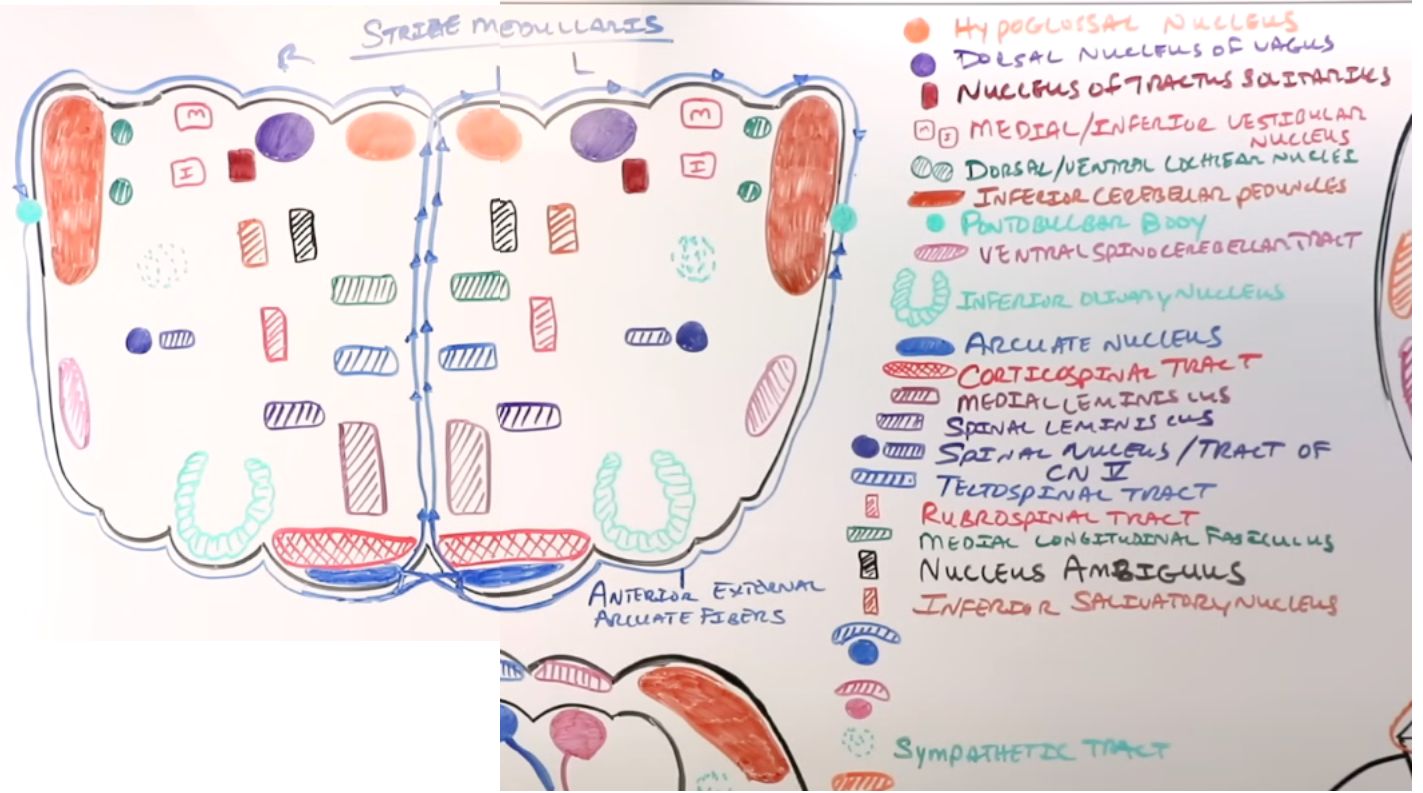
Medulla Pontomedullary Junction :: Ventral and Lateral

The arcuate nucleus[…] lies ventrally; its anterior external arcuate fibers project to the contralateral ponto-bulbar body. Posterior fibers run ipsilaterally and decussate as the striae medullaris[…].

The inferior olivary nucleus[…] sits ventrolaterally; just lateral runs the ventral spinocerebellar[…] tract.

From medial to lateral in the middle zone: the medial lemniscus[…], the spinal lemniscus, then the spinal nucleus of CN V[…] with its trigeminal tract.
Medulla Pontomedullary Junction :: Dorsal Cranial Nerve Nuclei

Just ventral to the most dorsal area: the nucleus ambiguus[…] provides branchial motor fibers to CN IX and X; the inferior salivatory nucleus[…] provides parasympathetic output for CN IX.

Nearby runs the descending sympathetic[…] tract.

In the dorsal zone: the hypoglossal (CN XII)[…] nucleus is medial; the dorsal motor nucleus of CN X[…] lies just lateral; the nucleus tractus solitarius (NTS)[…] processes taste and visceral input.

The vestibular nuclear complex at this level includes medial, inferior, dorsal cochlear[…], and ventral cochlear nuclei.
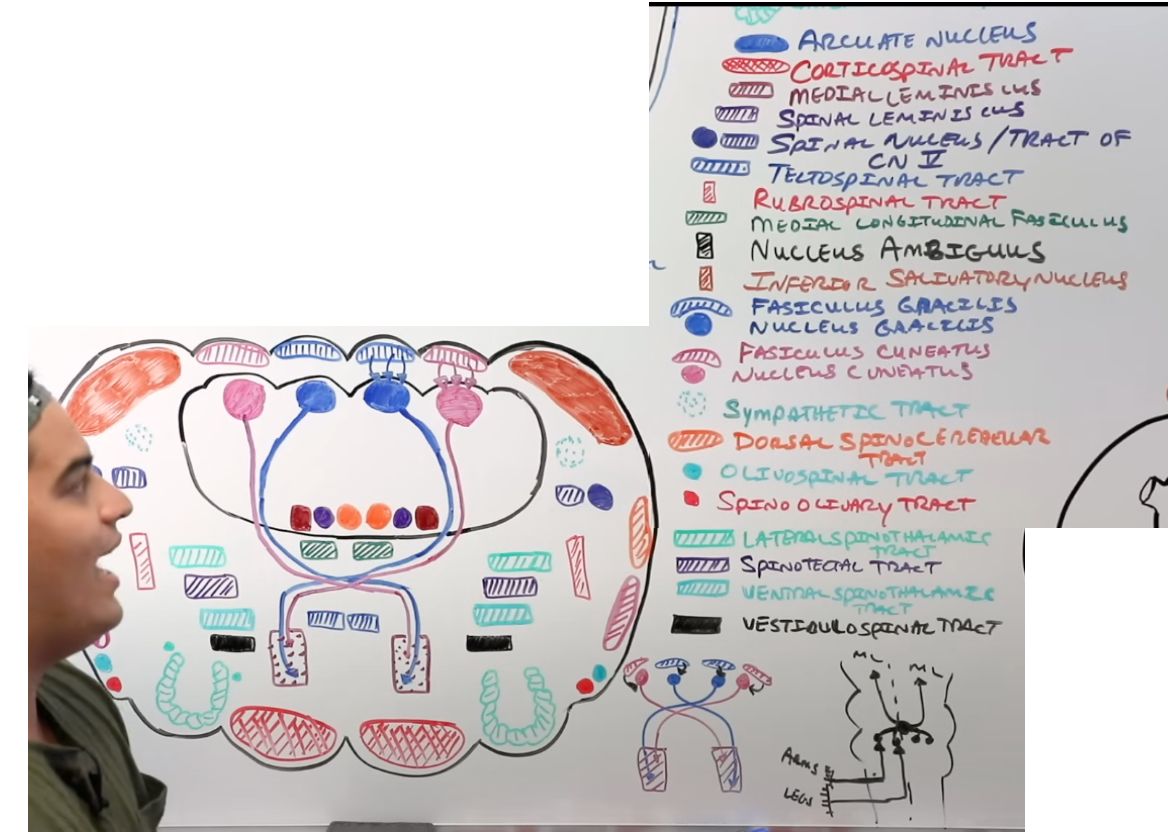
Medulla DCML Decussation :: Ventral and Lateral

Ventromedially: the corticospinal[…] tract; just lateral is the inferior olivary nucleus[…] (target of climbing-fiber input to cerebellum). The spino-olivary tract carries spinal input to the olive; the olivo-spinal tract projects back to the cord.

Three lemnisci pass through: medial (DCML[…]), spinal (STT[…]), and the lateral region near the spinal tract of CN V[…].

The vestibulospinal[…] tract is just lateral to the medial lemniscus; the ventral spinothalamic[…] is lateral/dorsal; the spino-tectal tract projects to the midbrain.
Medulla DCML Decussation :: Dorsal Nuclei and Decussation

The defining feature of this level is decussation of the DCML[…] fibers (internal arcuate fibers from gracilis/cuneatus nuclei cross to form the medial lemniscus).

Dorsally: the fasciculus gracilis[…] ends in the nucleus gracilis (lower body) and the fasciculus cuneatus[…] ends in the nucleus cuneatus (upper body).

Cranial nerve nuclei: hypoglossal (CN XII)[…] nucleus medially, dorsal motor nucleus of CN X[…] just lateral, and nucleus tractus solitarius[…] nearby.

The descending sympathetic[…] tract courses dorsolaterally; the inferior cerebellar peduncle[…] lies at the dorsal margin.
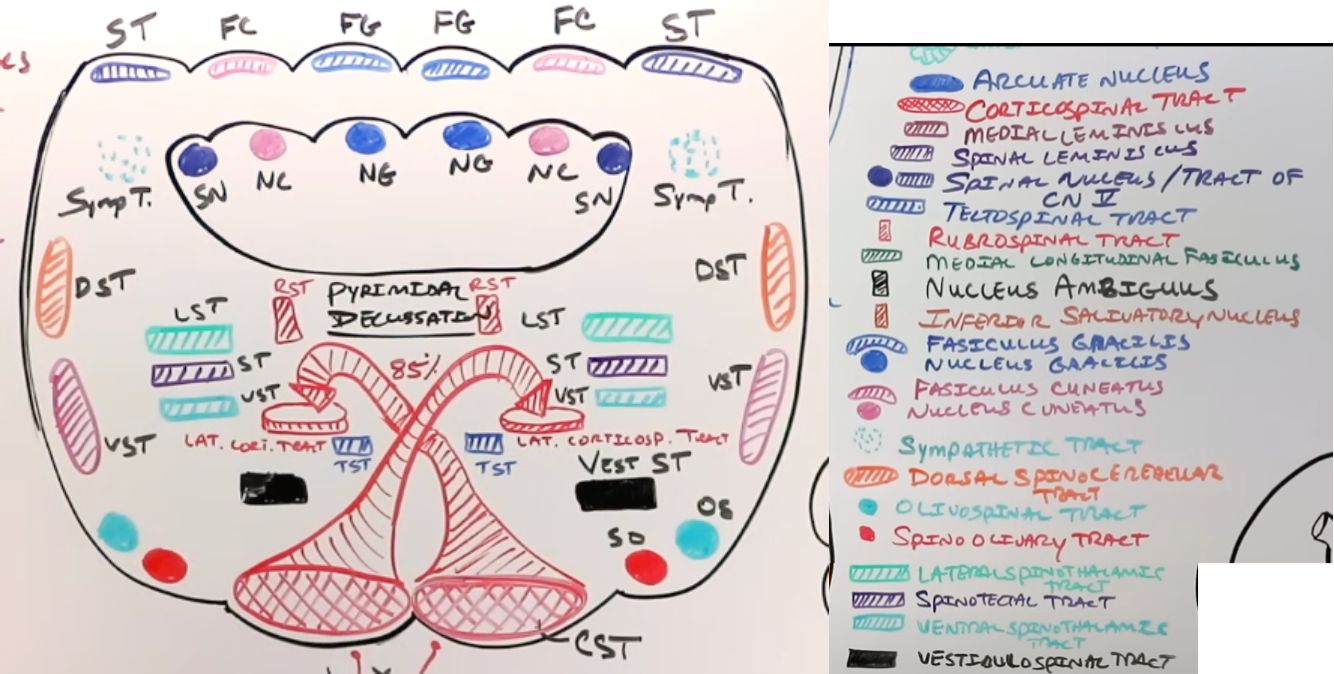
Medulla Pyramidal Decussation :: Ventral

The defining feature is pyramidal decussation[…] — corticospinal tracts cross at this level, with ~85% crossing to form the lateral CST and ~15% remaining ipsilateral as the anterior CST.

Nearby: the spino-olivary[…] and olivo-spinal tracts.

The ventral and dorsal spinocerebellar[…] tracts lie laterally.

Other ventromedial descending tracts: vestibulospinal[…], tectospinal[…].

The ventral spinothalamic[…] tract lies anteriorly; the spino-tectal tract projects to midbrain tectum.
Medulla Pyramidal Decussation :: Middle and Dorsal

The rubrospinal[…] tract lies medial to spinothalamic fibers.

Dorsally: fasciculus gracilis[…] continues to the nucleus gracilis; fasciculus cuneatus[…] to the nucleus cuneatus.

The spinal tract of CN V[…] is present, carrying pain/temperature from the face down to upper cervical segments.

This is the rostral-most level still resembling the spinal cord[…] architecture before the medulla expands more dorsally.
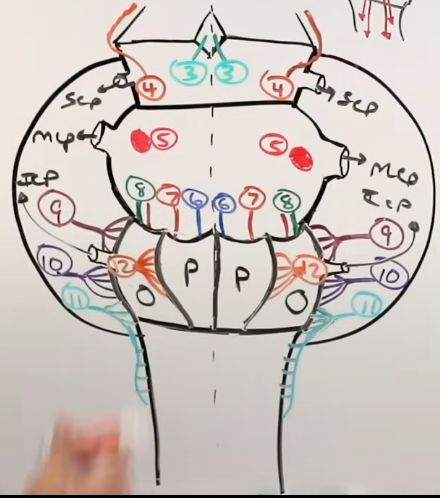
Brainstem CN Exit Points (Ventral View)

In the midbrain, CN III[…] exits ventrally (between the cerebral peduncles, interpeduncular fossa); CN IV[…] exits dorsally (the only CN to exit dorsally).

The superior[…] cerebellar peduncle lies laterally at the midbrain.

The only cranial nerve exiting from the body of the pons (not the pontomedullary junction) is CN V[…]; the middle[…] cerebellar peduncle forms the lateral border.

Medulla ventral landmarks (medial to lateral): pyramids → olives → inferior cerebellar peduncle[…].

At the pontomedullary junction: CN VI[…] exits medially, CN VII[…] just lateral, and CN VIII[…] even more lateral.

In the posterolateral sulcus of the medulla (top to bottom): CN IX[…], CN X[…], then CN XI (cranial part)[…].

In the anterolateral sulcus of the medulla, the exiting cranial nerve is CN XII[…].
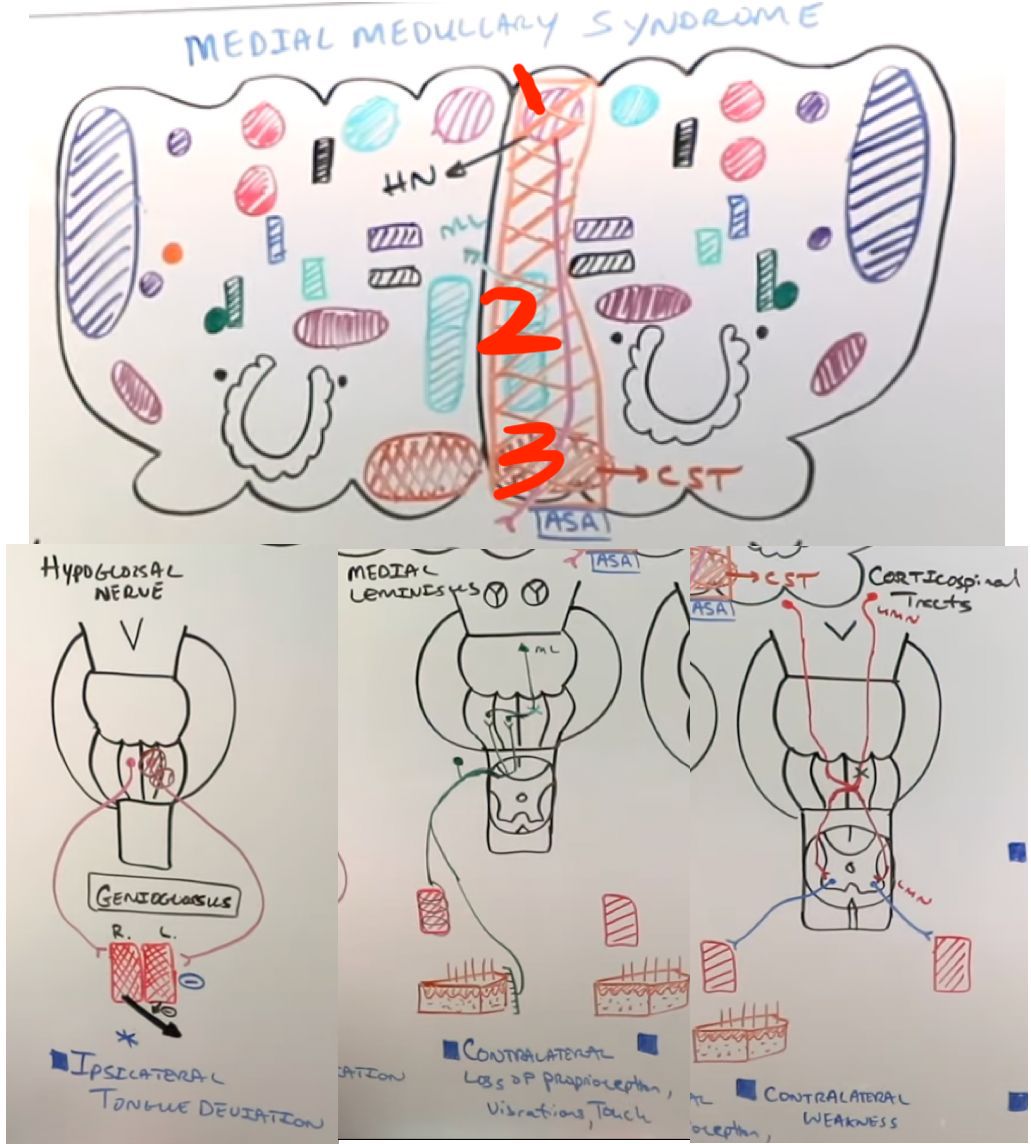
Medial Medullary (aka Dejerine[…]) Syndrome

  • Results from occlusion of the anterior spinal artery (ASA)[…].
  • Structures affected and corresponding deficits:
    1. CN XII (hypoglossal) nucleus[…] → ipsilateral tongue deviation (because contralateral muscles overpower).
    2. Medial lemniscus[…] → contralateral loss of fine touch, vibration, and proprioception.
    3. Corticospinal tract (pyramid)[…] → contralateral hemiparesis (face[…] spared, since this is below CN VII).
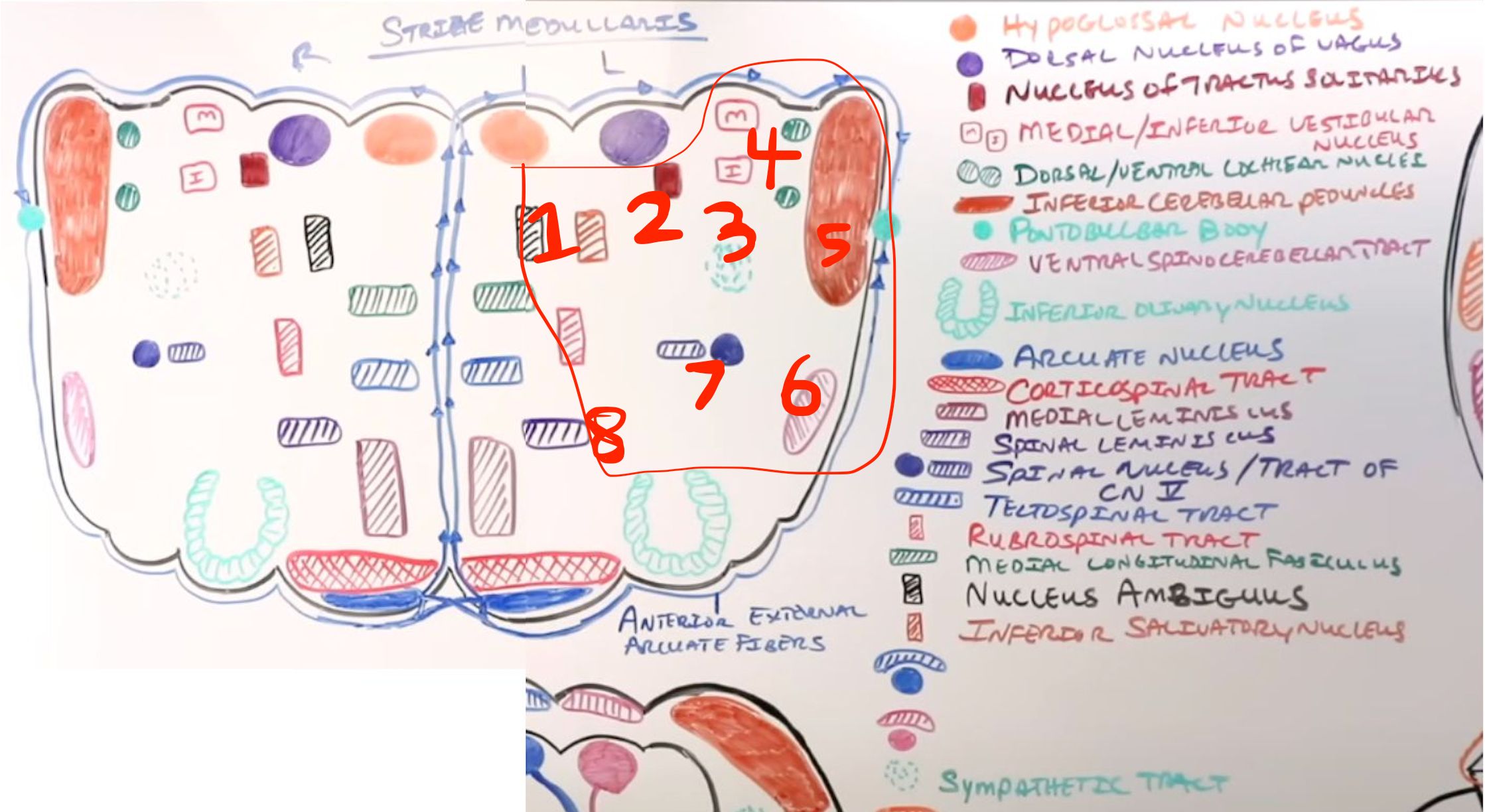
Lateral Medullary (Wallenberg) Syndrome

  • Lateral medullary syndrome (Wallenberg syndrome) results from occlusion of the PICA[…] (or vertebral artery).
  • Structures and deficits:
    1. Nucleus ambiguus[…] (CN IX/X) → dysphagia, hoarseness, loss of gag reflex.
    2. Nucleus tractus solitarius[…] → loss of taste from ipsilateral tongue (for CN7 ant 2/3, CN9 post 1/3) and loss of input from CN9 carotid/sinus bodies or other visceral structures like from CN9/CN10 (swallow, cough, gag, vomit)
    3. Descending sympathetic tract[…] → ipsilateral Horner syndrome
    4. Medial and inferior vestibular nuclei[…] + Dorsal + Ventral Cochlear Nuclei[…] → nausea/vomiting, vertigo, nystagmus, + hearing loss
    5. Inferior cerebellar peduncle[…] → ipsilateral ataxia
    6. Spinocerebellar tract[…] → ipsilateral ataxia
    7. Spinal nucleus and tract of CN V[…] → ipsilateral facial pain/temperature loss
    8. Spinothalamic tract (spinal lemniscus)[…] → contralateral body pain/temperature loss
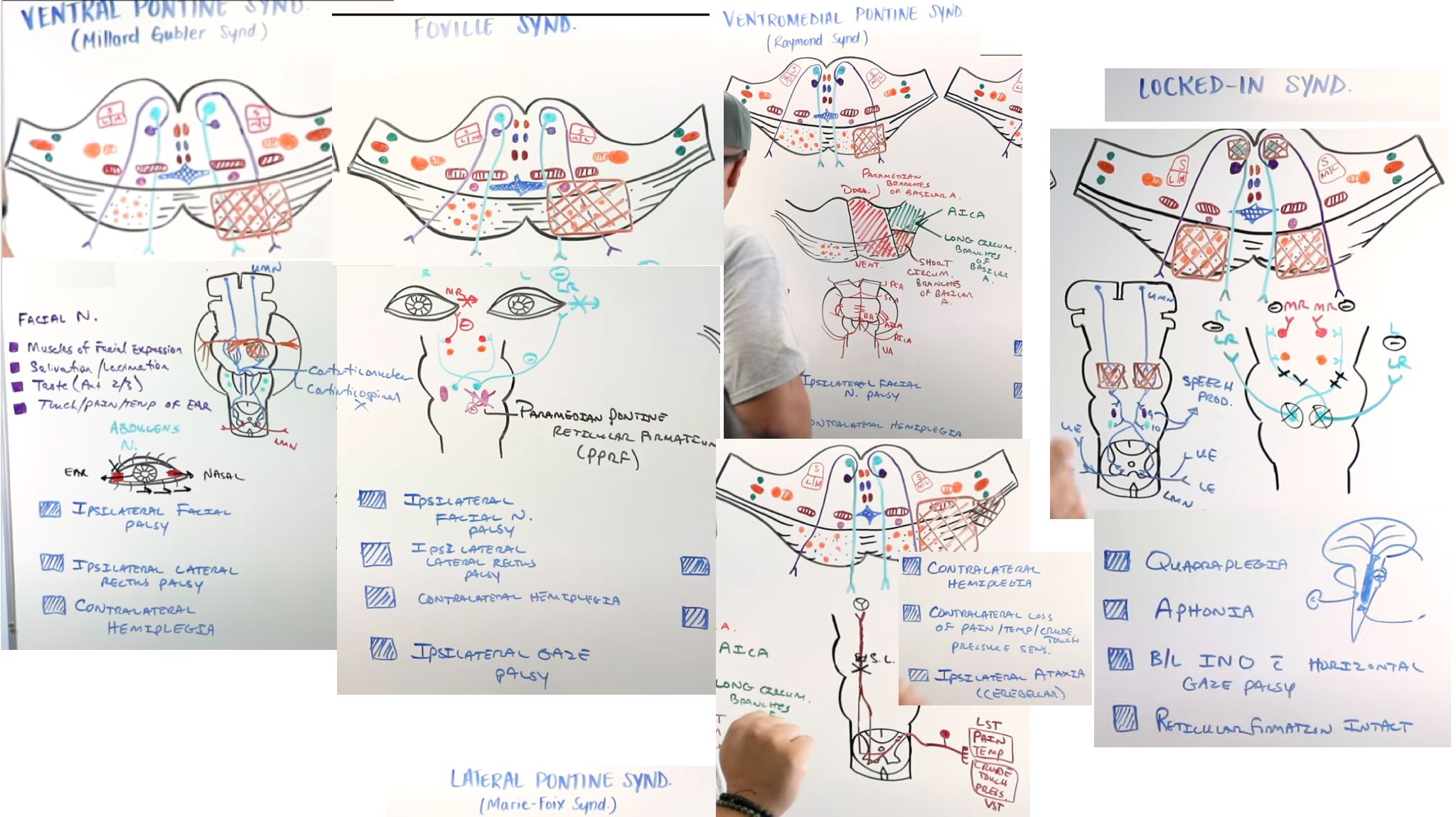
Pons Lesions - Arterial Supply and Stroke Syndromes

  • Paramedian branches[…] of the basilar artery supply the medial pons; occlusion causes medial pontine syndrome with contralateral hemiparesis (CST), contralateral DCML loss (medial lemniscus), and ipsilateral CN VI or VII palsy.
  • Short circumferential branches[…] of the basilar artery supply ventral and lateral pons; occlusion causes deficits affecting CST, spinothalamic, and trigeminal pathways.
  • Long circumferential branches[…] (AICA, SCA) supply dorsolateral pons and superior cerebellum; AICA occlusion classically causes lateral pontine syndrome (ipsilateral facial weakness, hearing loss, Horner's, ataxia; contralateral pain/temperature loss).