Cerebellum

Cerebellum

Anatomy · 13 cards

Cerebellum :: Gross Anatomy and Lobes

The outer layer of folia[…] is gray matter, folded to increase surface area.

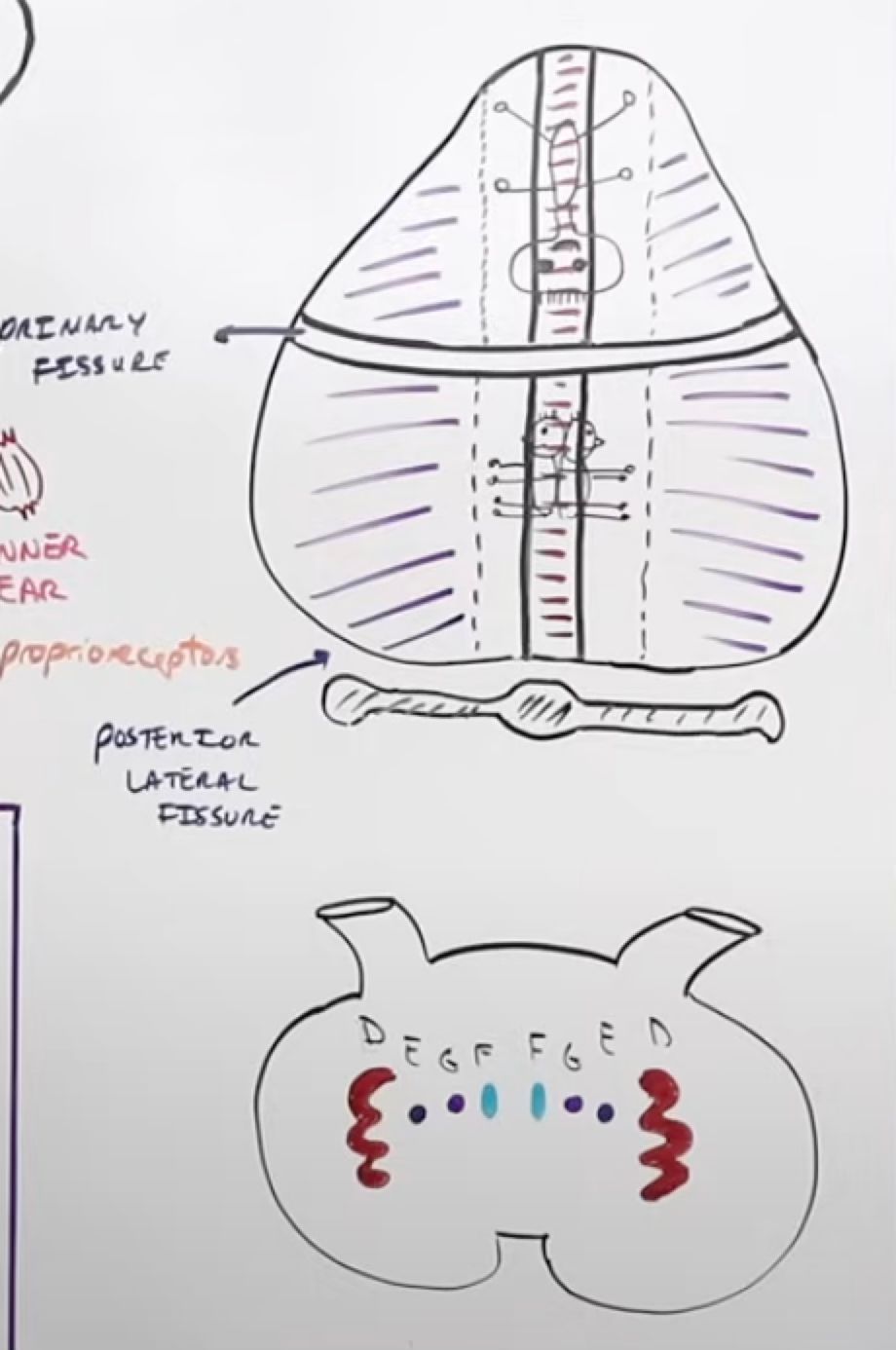
The primary[…] fissure and posterior lateral[…] fissure divide the cerebellum into three lobes: anterior, posterior, and flocculonodular[…].

Midline-to-lateral organization: vermis[…] (midline) → paravermis (intermediate zone)[…] → lateral hemisphere.
Cerebellum :: Functional Divisions

The anterior lobe is the spinocerebellum[…]; its vermis represents the homunculus of head/neck/trunk, and the paravermal zone represents arms and legs[…]. Main function: proprioception[…] from body parts and modulating axial/limb posture.

The posterior lobe is the cerebrocerebellum[…] (lateral hemispheres); main function: processing the motor plan[…] from cortex and coordinating skilled, learned movements.

The flocculonodular lobe is the vestibulocerebellum[…]; processes vestibular[…] information from the inner ear (balance, eye-head coordination).
Cerebellum :: Deep Nuclei

Mnemonic: "Don't Eat Greasy Food" = Dentate, Emboliform, Globose, Fastigial[…] (lateral → medial).

The dentate[…] nucleus lies in the lateral hemisphere — outputs of the cerebrocerebellum.

The emboliform[…] and globose[…] nuclei (collectively interposed) lie in the paravermal and vermal areas — outputs of the spinocerebellum's intermediate zone.

The fastigial[…] nucleus is the most medial (near the flocculonodular lobe) — outputs of the vestibulocerebellum and vermis.
Cerebellum Layers
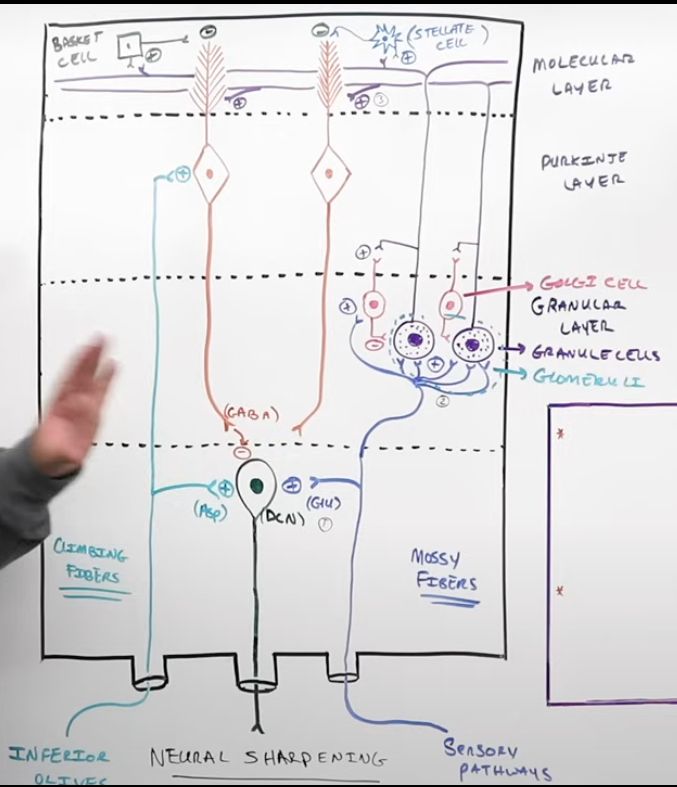
  • From outer to inner: molecular → Purkinje → granular → deep nuclei[…]
  • The molecular layer contains (2) stellate and basket[…] cells and parallel fibers (granule cell axons)
  • The Purkinje layer contains Purkinje cells[…] — the sole output of the cerebellar cortex. Purkinje cells release GABA[…] to INHIBIT deep nuclei
  • The granular layer contains granule cells and Golgi cells[…]. The fine balance of excitation and inhibition produces neural sharpening[…]
Cerebellum :: Climbing Fibers (Inferior Olive)
  • Climbing fibers originate from the contralateral inferior olive[…]
  • Some axons release aspartate[…] to directly EXCITE the deep nuclei
  • Other axons ascend to the Purkinje[…] layer, exciting Purkinje cells (which then release GABA[…] to inhibit deep nuclei)
  • Functionally, climbing fibers encode error signals[…] used for motor learning
Cerebellum :: Mossy Fibers and Inhibitory Interneurons
  • Mossy fibers come from sensory pathways[…] (spinocerebellar, pontocerebellar, vestibular, reticular).
  • Some axons release glutamate[…] to directly EXCITE the deep nuclei.
  • Others continue to the granular[…] layer, exciting granule cells. Granule cells ascend and branch in the molecular[…] layer as parallel fibers, exciting stellate cells, basket cells, and Purkinje cells.
  • Stellate and basket cells inhibit[…] Purkinje cells, which reduces Purkinje GABAergic output — letting deep nuclei escape inhibition.
  • Golgi cells inhibit granule cells; granule cells excite Golgi cells — a negative-feedback loop sharpening signal-to-noise.
Cerebellum :: Afferents — Spinocerebellar Pathways

The ventral spinocerebellar[…] tract carries proprioception from L2/L3 and below.

The rostral spinocerebellar[…] tract carries proprioception from the cervical cord and upper extremities.

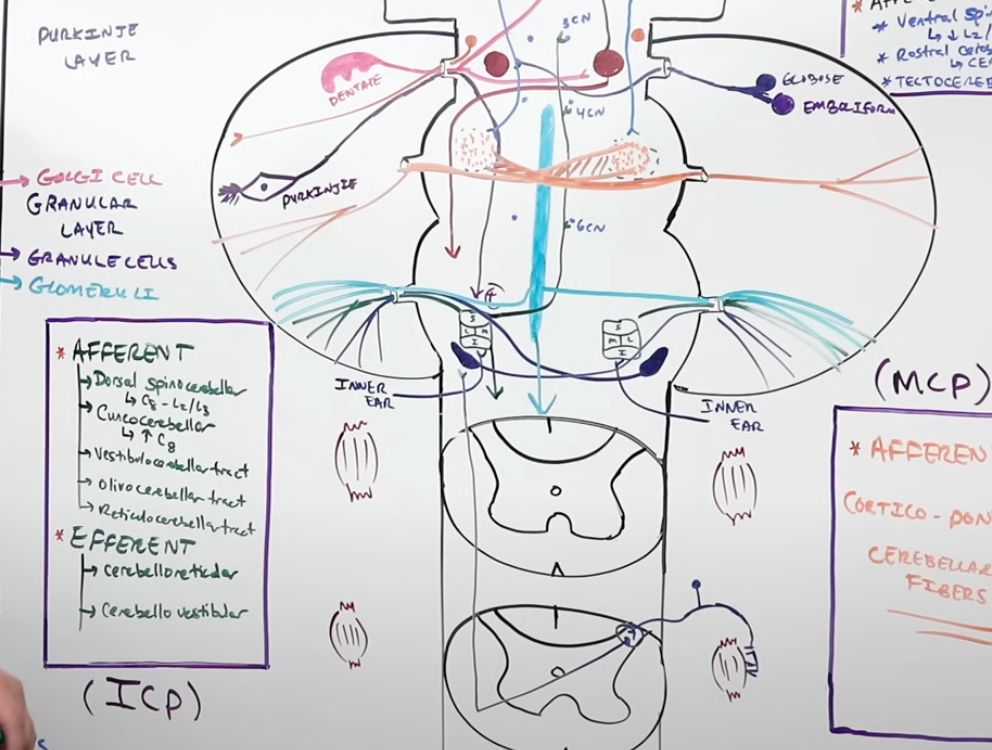
The dorsal spinocerebellar[…] tract carries ipsilateral proprioception from C8 to L2/L3, entering via the inferior cerebellar peduncle (ICP)[…].

The cuneocerebellar[…] tract carries ipsilateral proprioception from above C8 (also via ICP).
Cerebellum :: Afferents — Cortico-Ponto-Cerebellar Pathway

Primary motor cortex, primary somatosensory cortex, and motor association areas generate the motor plan, coordinating with the basal ganglia[…].

The plan descends via ipsilateral cortico-pontine[…] fibers, synapsing in the pontine nuclei[…].

From pontine nuclei, ponto-cerebellar[…] fibers CROSS to the contralateral cerebellum, entering via the middle cerebellar peduncle (MCP)[…].

Because efferents will cross again, the cortical motor plan ultimately reaches the ipsilateral (to the cortex)[…] cerebellum — explaining why a left cerebellar lesion produces left-sided ataxia.
Cerebellum :: Afferents — Vestibulo, Olivo, Reticulo, Tecto

The vestibulocerebellar[…] tract carries equilibrium info from the inner ear via vestibular nuclei to the flocculonodular lobe (via ICP).

The olivocerebellar[…] tract (climbing fibers) originates contralaterally in the inferior olive[…], crosses, and enters via the contralateral ICP to reach the ipsilateral cerebellum.

The reticulocerebellar[…] tract carries input from the reticular formation.

The tectocerebellar[…] tract carries input from the superior and inferior colliculi[…] (visual + auditory).
Cerebellum :: Efferents — Dentate Nucleus

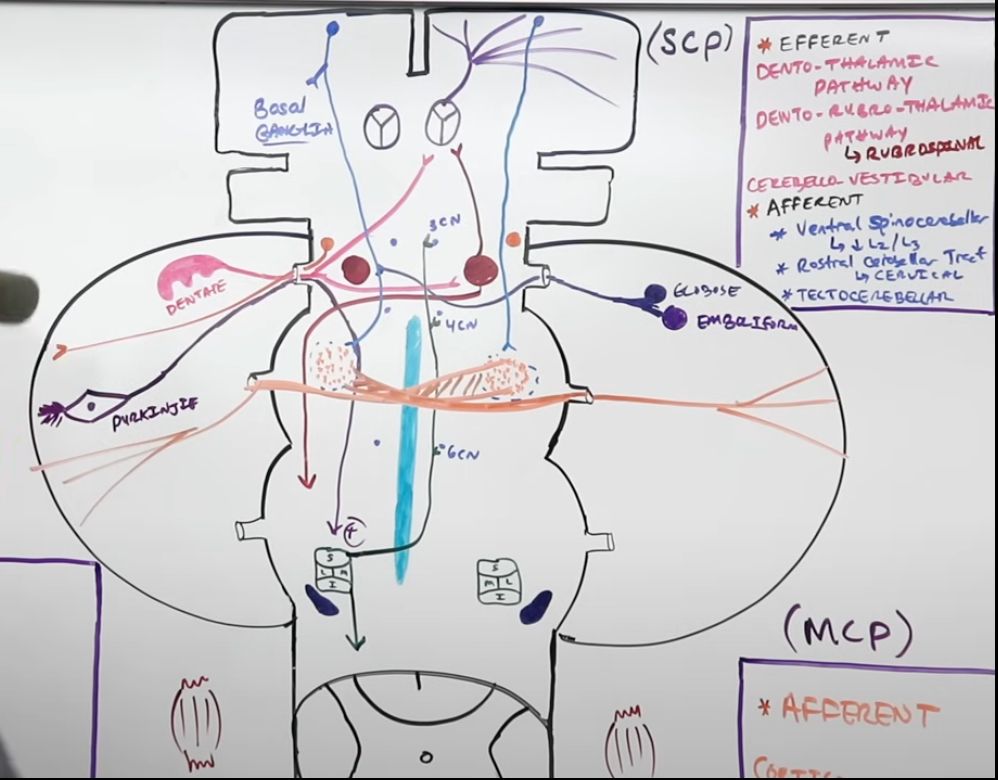
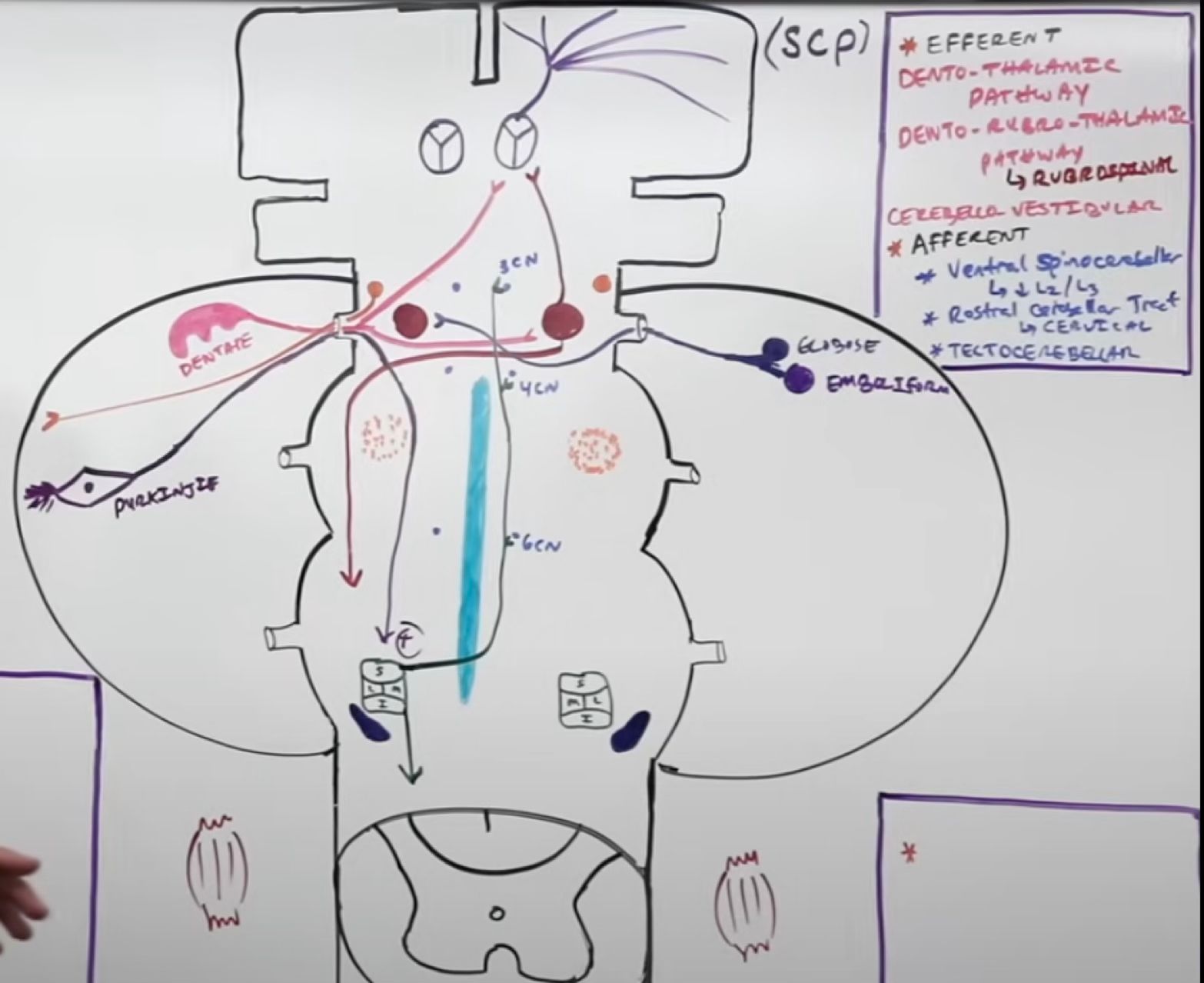
The dentate[…] nucleus exits via the superior cerebellar peduncle (SCP)[…], which DECUSSATES.

Two pathways:
1. Dento-thalamic[…]: → contralateral VL of thalamus → ipsilateral primary motor, primary somatosensory, and motor association cortices.

2. Dento-rubro-thalamic[…]: → contralateral red nucleus → thalamus → cortex (and the red nucleus also drives the contralateral descending rubrospinal[…] tract).

Net effect: each cerebellar hemisphere influences the ipsilateral[…] body (because both the cerebellar efferent AND the corticospinal tract cross once each).
Cerebellum :: Efferents — Globose/Emboliform and Fastigial

The globose[…] and emboliform[…] (interposed) nuclei project via SCP to the contralateral red nucleus[…], activating the contralateral descending rubrospinal[…] tract — which targets LMNs of flexor muscles of the distal[…] extremities.

The fastigial[…] nucleus projects to the reticular formation, where the medullary reticulospinal tract drives flexion[…] and the pontine reticulospinal tract drives extension[…].

Net effect: interposed = distal limb flexor coordination; fastigial = axial/postural balance.
Cerebellum Efferent Pathways

  • Purkinje fibers from the flocculonodular lobe exit directly (without synapsing in deep nuclei) to project to the ipsilateral vestibular[…] nuclei in the brainstem.
  • Vestibular nuclei then send:
    • Ascending fibers via the contralateral MLF[…] to CN III, IV, VI — coordinating extraocular muscles (VOR).
    • Descending fibers via the vestibulospinal[…] tract to excite extensor (antigravity)[…] muscles.
Cerebellum: Summary of Cerebellar Peduncles
  • The inferior cerebellar peduncle (ICP)[…] carries: DSCT, cuneocerebellar, olivocerebellar (climbing fibers), vestibulocerebellar, and reticulocerebellar afferents — plus fastigial efferents to vestibular and reticular nuclei.
  • The middle cerebellar peduncle (MCP)[…] carries: ponto-cerebellar fibers ONLY (purely afferent, carrying the cortical motor plan).
  • The superior cerebellar peduncle (SCP)[…] carries: ventral spinocerebellar AFFERENTS and most cerebellar EFFERENTS (dentato-thalamic, dentato-rubro-thalamic, interposed-to-red-nucleus) — decussates at the level of the inferior colliculus[…].