Behavioral Psych

Behavioral Psych

Subspecialties Β· 26 cards

Cognitive Symptoms - Clinical Approach

Clarify the presenting symptom: "Memory loss" for words β†’ actually aphasia[…]; "Memory loss" for every day actions β†’ actually working memory/attention[…] impairment; "Memory loss" for faces β†’ actually prosopagnosia[…].

Functional capacity: preserved in MCI[…]; progressively impaired in dementia[…].

Cognitive domains: Attention[…]: assessed first; needed for all other domains; tested with forward digit span, backward digit span, serial 7s, Trail Making[…] test, letter cancellation.

Language[…]: articulation, fluency, prosody, grammar/syntax.

Phonemic paraphasias = wrong phoneme ("gaise" for "raise"); semantic paraphasias[…] = wrong word ("orange" for "apple"); agrammatism = telegraphic speech; aprosodia = loss of melodic tone (nondominant hemisphere).

Memory[…]: focus on explicit/declarative.

Retrograde = old events; anterograde = can't form new (localizes to hippocampus[…]).

True amnesia = no free or cued recall; retrieval disorder = cued recall preserved (localizes to frontal/subcortical[…] region).

Visuospatial[…]: apperceptive agnosia (can't copy figure) vs associative agnosia (can't access stored knowledge β€” prosopagnosia, pure alexia, achromatopsia, visual object agnosia[…]).

Executive[…]: multitasking tests.

Cognitive impairment phenotypes by localization: Amnestic β†’ limbic system[…]; Language β†’ dominant hemisphere; Visuospatial β†’ parietooccipital or temporooccipital; Dysexecutive β†’ prefrontal cortex or subcortical connections[…] (BG > thalamus, cerebellar).

Exam findings: Paratonia (can't relax) β†’ frontal-subcortical dysfunction; Frontal release signs (grasp/snout/glabellar/palmomental): little diagnostic value, can be seen in healthy adults; Cortical sensory loss: tested with graphesthesia, stereognosis, extinction[…]. Diagnostics: serum CMP + B12 + TSH Β± HIV/syphilis; MRI brain Β± LP if infectious/autoimmune; EEG if prion suspected, fluctuating symptoms, or seizures concern.
Aphasias - Broca and Wernicke

Broca's aphasia: Symptoms: simplified syntax, "nonfluent, telegraphic[…]" speech; Comprehension impaired[…] via agrammatism; Repetition impaired; Lesion: L frontal/temporal stroke; often shows up as diaschisis resolves[…] after initial global aphasia; Pathophys: damage to pathway linking auditory cortex β†’ mid-superior temporal gyrus β†’ external/extreme capsule β†’ Broca's area[…]; May also see impaired grammatic comprehension.

Wernicke's aphasia: Symptoms: anomia, word deafness, neologisms, phonemic paraphasias[…]; Comprehension impaired; repetition impaired; Example phonemic paraphasias: "The predident libs in doshington" for "The president lives in Washington"; Lesion: L MCA perisylvian cortex[…] with adjacent temporal and parietal regions; At temporal semantic association cortices β†’ anomia + impaired comprehension; At connections between auditory cortex and superior temporal gyrus β†’ word deafness[…] (can't understand words normally heard/read/written).

Anatomical networks for a "dog" concept: Visual association[…] cortex: perceives appearance; Orbitofrontal and limbic cortices: emotional associations; Dominant perisylvian[…] cortex: linguistic representation; Somatosensory cortex: feel of fur/tongue; Auditory cortex: barking sounds; Dorsolateral frontal cortex: predicative component (what dogs do).

Diaschisis[…]: brain connections damaged β†’ neurons lose afferent inputs β†’ modify synapses to recover physiology (e.g., stroke recovery).
Aphasias - Conduction, Anomic, Transcortical

Conduction aphasia: Basically Wernicke's with sparing of comprehension[…]; Repetition impaired (can't repeat or sequence sentences/nonwords) + phonemic paraphasias + decreased auditory-verbal short-term memory; Lesion: stroke in posterior superior temporal gyrus near supramarginal gyrus[…].

Anomic aphasia: Word-finding difficulty; Comprehension preserved; repetition preserved; Lesion: stroke in same region as Wernicke's but sparing perisylvian cortex[…] (so no phonemic paraphasias).

Transcortical aphasia: L hemisphere stroke sparing perisylvian cortex[…] β†’ sparing of repetition[…]. Transcortical motor aphasia: Decreased spontaneous speech production but preserved with visual cues (e.g., describe a picture); Repetition preserved; comprehension mostly preserved.

Transcortical sensory aphasia: Like Wernicke's but with preserved repetition; Often has echolalia[…] (repeating examiner's question instead of answering); Comprehension impaired.
Memory Types and Anatomy

Explicit/declarative (conscious retrieval): Working/short-term[…] memory: seconds-minutes (e.g., remembering a phone number to dial).

Anatomy: DLPFC + VLPFC + parietal lobes[…].

Long-term memory[…]: encoded during slow-wave deep sleep.

Episodic[…]: what/where/when of specific events (anatomy = Papez circuit[…]).

Semantic[…]: facts obtained over time (anatomy = PFC + anterior temporal cortex[…]).

Papez circuit: somatosensory cortex + association areas β†’ frontal lobe β†’ enters hippocampus[…] via entorhinal/perirhinal/parahippocampal cortex β†’ integrated in dentate gyrus (CA3) β†’ CA1[…] β†’ back to entorhinal/perirhinal cortex for consolidation β†’ long-term cortical storage.

Damage by location: Any circuit component: significant episodic memory[…] issues with mostly anterograde amnesia; Hippocampus: anterograde amnesia + some retrograde (most recent memories lost); Anteromedial thalamic nuclei[…]: anterograde amnesia; Basolateral limbic system (amygdala, orbitofrontal, dorsomedial thalamus): memory issues + KlΓΌver-Bucy[…] syndrome (hypersexual, hyperoral, hyperphagia); Mammillary bodies or medial dorsal thalamus or pulvinar nucleus: Wernicke-Korsakoff[…] syndrome. Implicit/non-declarative: procedural memory (riding a bike).

Anatomy: supplementary motor cortex + parietal lobes + BG + cerebellum[…].
Memory Disorders Differentiation

Retrieval vs encoding deficit: PFC lesion[…]: impaired free recall but preserved cued recall (retrieval deficit) β†’ implies sparing of limbic system; True amnesia (encoding deficit): can't do free or cued recall.

Retrograde amnesia patterns: Equal recent and remote: likely functional[…] amnesia; Recent > remote: medial temporal lobe[…] (Alzheimer's) or medial diencephalon injury (bithalamic infarcts, Korsakoff).

DLB vs AD initial features: AD: episodic memory[…] + visuospatial β†’ word-finding β†’ hallucinations; DLB: working memory + RBD[…] β†’ visual hallucinations + parkinsonism.

Associated findings with memory loss: Oculomotor apraxia β†’ think CBS or Balint (PCA)[…]; Supranuclear vertical gaze palsy β†’ think PSP; Ophthalmoplegia/nystagmus β†’ think Wernicke-Korsakoff[…]; Asymmetric UMN signs β†’ CBS or vascular or focal AD variants; Weakness, atrophy, fasciculations β†’ FTD-ALS[…]; Parkinsonism β†’ DLB, vascular, FTD, CBS.

Key disorders: AD: amnestic phenotype most common; anterograde episodic memory most affected; DLB: memory deficits often improve with cues[…]; SVD: free recall improves with cues; TGA (Transient Global Amnesia)[…]: sudden anterograde Β± retrograde amnesia without other neuro symptoms; recover completely; diagnostics usually normal; mechanism unknown; Wernicke-Korsakoff (B1 deficiency): significant anterograde amnesia Β± confabulation[…] + nystagmus + ophthalmoplegia.
Prefrontal Cortex Subdivisions

Core PFC functions: working memory + set-shifting + response inhibition. Frontal-subcortical circuit: frontal lobe β†’ striatum β†’ globus pallidus β†’ SN β†’ thalamus[…] β†’ back to frontal. Lesions in subcortical structures (e.g., caudate) can produce frontal-lobe type symptoms.

Memory cue test: memory improving with cues suggests DLPFC (retrieval)[…] dysfunction rather than hippocampal (encoding)[…] dysfunction. Subdivisions:

DLPFC[…]: planning, sequencing, attention, working memory.: Lesions β†’ planning issues + perseveration + sequencing errors + impaired episodic memory improved with cues; Tests: Luria sequence, Wisconsin Card Sorting, Trail Making[…].

VLPFC: Right[…] side β†’ spatial attention + response inhibition; Left[…] side β†’ language; lesions cause aphasia.

Orbitofrontal cortex[…]: social behavior, reward/punishment learning, empathy, personality, hunger and sexual regulation.: Lesions β†’ impaired inhibition, lack of empathy, personality changes (sociopathy), hyperphagia, hypersexuality[…].

Medial PFC + ACC[…]: motivation, conflict monitoring, goal-directed behavior.: Pathologies: ACA strokes or Acomm aneurysms. Unilateral lesions: apathy + decreased initiation + reduced verbal/motor output.

Bilateral lesions: akinetic mutism or severe abulia[…], urinary dysfunction, indifference to pain.

May see utilization behavior[…] (automatically grasp/use objects in sight).

Frontopolar (rostral PFC)[…]: multitasking, prospective memory, theory of mind, metacognition. Lesions β†’ disorganized behavior + impaired multitasking + difficulty switching contexts + deficits in creative thinking.

Dysexecutive Alzheimer Disease (dAD): young[…]-onset AD with predominant executive dysfunction[…] β€” multitasking issues + forgetting how to do tasks (vs events in typical AD).

Affects executive function with initial sparing of hippocampus[…] and parietofrontal atrophy/hypometabolism (vs hippocampal/medial temporal atrophy and temporoparietal hypometabolism in typical AD).
Upper Limb Apraxia

Definition: loss of ability to perform learned skilled movements not explained by sensory loss, motor disorders, severe cognitive impairment, or abnormal movements. Ideomotor apraxia: errors in skilled movement execution.: Examples: using body part as tool (fingers as scissor blades), positional/spatial errors, joint movement errors; Testing (worst to best): pantomime to command β†’ imitation β†’ actual tool use[…]; Pathophys (R-handed):; Corpus callosum[…] lesion β†’ L hand apraxia; L parietal lobe (supramarginal gyrus[…]) β†’ bilateral symptoms; can't discriminate correct vs incorrect pantomimes; L premotor/SMA β†’ bilateral symptoms; can discriminate but can't execute.

Limb-kinetic apraxia: loss of fine finger/hand dexterity.: Testing: coin rotation, grooved pegboard[…]; Pathophys: CC β†’ L hand apraxia (R-handed); L hemisphere β†’ ipsi/bilateral symptoms; Common in CBD and PD[…].

Conceptual apraxia: loss of tool/mechanical knowledge.: Testing: alternative tool selection[…] (remove correct tool, ask patient to select alternative β€” e.g., needs to remove screw, says "we don't have a screwdriver" and can't recognize pliers would work); Examples: tool selection issues, toolβ†’action association issues; Pathophys: localizes to L hemisphere.

Ideational apraxia: impaired action sequencing β€” e.g., for sandwich: puts bread together, cuts, then adds ham/cheese, then mustard (individual actions there, sequence wrong).: Testing: multistep task observation; Pathophys: frontal-executive[…] dysfunction (frontal TBI, stroke, vascular dementia).
Spatial Neglect and Anosognosia
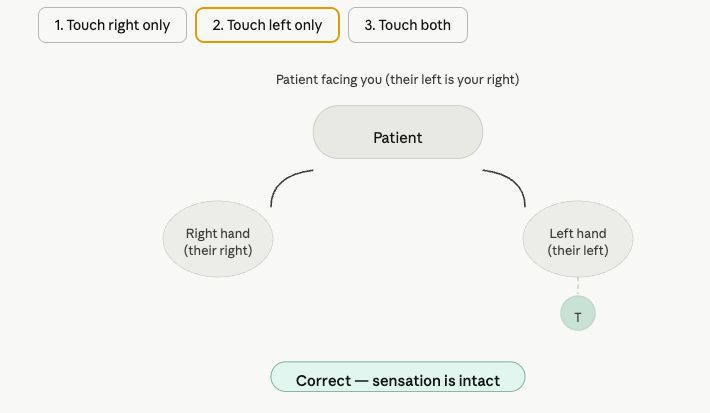
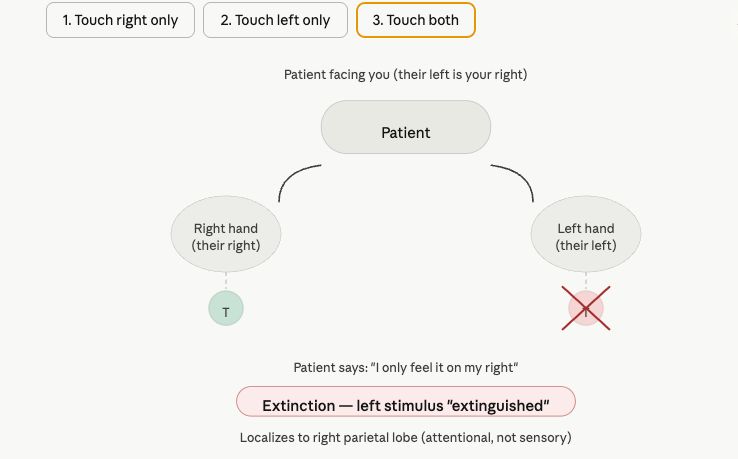
  • Spatial neglect: asymmetric responding/orienting to one side of space, not due to vision problem. Patients often deny the issue[…] (= anosognosia).
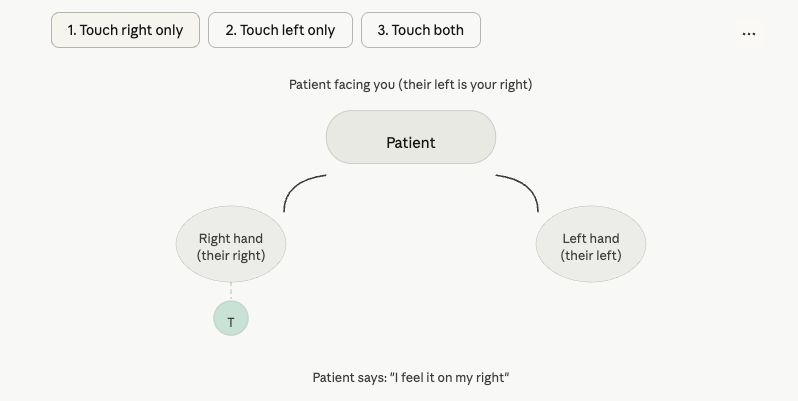
    • Symptoms: "Where" (perceptual-attentional[…]): impaired stimulus detection on one side. Test: extinction to double simultaneous stimulation (touch L+R together β†’ patient reports only R). Tactile, visual, auditory modalities. Extinction in 2 modalities suggests hemineglect.
    • Anatomy: temporoparietal association cortex[…]. "Aiming" (motor-intentional[…]): impaired movement initiation on one side. Includes gaze/head deviation toward lesion side, postural rotation, directional hypokinesia, contralateral limb underuse, navigation bias. Localizes to anterior motor-related subcortical networks. 
    • Bedside tests: extinction testing + line bisection + cancellation + reading.
    • Treatment: PT/OT with first-line prism adaptation therapy[…] (wedge prism shifting visual field toward lesion side + repeated hand movements).
  • Anosognosia spectrum (in order of severity): Anosodiaphoria[…]: knows about deficit but doesn't care; Anosognosia: denies deficit exists; Asomatognosia[…]: loss of ownership feeling for impaired body part; Somatoparaphrenia[…]: distorted/delusional experience of impaired body part; Misoplegia[…]: hatred of dysfunctional body part and attempts to harm it.
    • Anatomy: R hemisphere injury[…] (NOT a psychiatric disease/denial).
"extinction to double simultaneous stimulation on the left"


Concussion - Behavioral and Cognitive

Definition: acceleration/deceleration injury of brain after direct head force. Pathophys: trauma shears/strains white matter and deforms axons β†’ glutamate channels open β†’ Ca+2 and Na+ influx with K+ efflux[…] β†’ increased energy demands β†’ decreased CBF causing supply-demand mismatch β†’ altered neurotransmission + chronic inflammation/oxidative stress.

Clinical subtypes: Cognitive[…] dysfunction (brain fog): reduced attention + reaction time + processing speed; deficits in working memory + executive dysfunction; Ocular motor[…] dysfunction: pressure behind eyes, blurry vision, photosensitivity, eye fatigue, convergence insufficiency, saccade/smooth pursuit issues; Vestibular[…] dysfunction: dizziness, nausea/vomiting, dysequilibrium worse with rapid head movements; Migraine headache: moderate-severe migrainous features; risk increased with premorbid migraine or psych dx; Anxiety/mood[…] dysfunction: anxiety, depression, insomnia, anger/irritability.

Associated conditions: Sleep disturbances: insomnia or daytime sleepiness; Cervical strain[…]: neck pain/stiffness + occipital/suboccipital HA from upper neck soft tissue strain β†’ disrupts cervical afferents.

Diagnostics: FDA-approved blood test: UCH-L1 (neuron) + GFAP (glia)[…] predict traumatic intracranial injury on CT (risk-stratifies whether CT is needed, NOT to predict mild TBI); CT brain to rule out structural abnormalities; DTI is emerging (mostly research).

Persistent postconcussive syndrome: symptoms persisting for weeks-months; vestibular[…] subtype increases risk; often neurobiopsychosocial factors (fear-avoidance, negative expectations) rather than unrecovered concussion.

Treatment: 1st line: rest for 24-48 hours[…] β†’ gradual moderate-intensity activity (avoid prolonged rest or premature activity); Be cautious with meds with adverse cognitive effects (e.g., topiramate); Procedures: trigger-point injections, occipital nerve block, botox + PT/OT/vestibular PT/Epley/cognitive rehab.
Psychosis - Hallucinations and Delusions

Definition: severe impairment in thoughts/emotions; patient unable to distinguish reality from internal experience. Hallucinations by type: Auditory[…]: schizophrenia, schizoaffective, bipolar I/II, MDD with psychosis, PTSD flashbacks; Visual[…]: delirium (hospitalized/old/ICU), DLB or PD, Charles Bonnet syndrome[…] (eye diseases β†’ brain compensates with images), peduncular hallucinosis; Passage visual: brief vision of person/animal/shadow in peripheral field; Presence visual: feeling someone is nearby; DLB has more well-formed[…] visual hallucinations (children, people, animals, scenes) compared to PD; Pareidolia[…]: perception of meaningful objects (faces, animals) in visual scenes β€” Lewy body diseases; Olfactory: temporal lobe epilepsy, brain tumors; Gustatory: seizures, psychiatric; Tactile: substance use, DTs.

Stroke-induced visual hallucinations: Peduncular hallucinosis[…]: midbrain/thalamic lesions β†’ vivid naturalistic visual hallucinations from release phenomenon[…] from damaged RAS pathways; R hemispheric lesions β†’ post-stroke psychosis; Occipital stroke β†’ simple visual hallucinations (light, shape, shadows) in hemianopic field.

Differential: Illusion[…]: distorted version of real external stimulus; Pseudohallucination[…]: vivid sensory experience from one's own mind; Hypnagogic/hypnopompic: during sleep transitions; Derealization (world unreal) vs depersonalization (self unreal/detached).

Delusions: false fixed beliefs despite contrary evidence.: Persecutory[…]: harassment + paranoia; Grandiose: inflated self-worth; Erotomanic: belief another person is in love with them; Jealous: belief partner is unfaithful; Somatic: false belief about body functions; Nihilistic: belief self/others/world doesn't exist; Reference: belief events/objects have special personal significance.

Delusional misidentification syndromes (often R hemispheric[…] involvement): Capgras[…]: belief familiar person replaced by imposter. (Differs from prosopagnosia: emotional connection and voice/gait recognition preserved.). Fregoli: belief familiar people repeatedly change disguise and follow patient. Intermetamorphosis: belief familiar people exchanged identities. Subjective doubles: belief in doppelganger. Mirrored-self misidentification: reflection perceived as stranger.

Reduplicative paramnesia[…]: belief a place has been relocated or duplicated.
Schizophrenia Spectrum and Atypical Psychosis Causes

Schizophrenia spectrum: Schizotypal personality disorder[…]: odd/eccentric behaviors and speech, odd beliefs, magical thinking, lack of close friends; Brief psychotic disorder[…]: β‰₯1 schizophrenia symptom for <1 month; return to baseline; Schizophreniform disorder[…]: schizophrenia symptoms for 1-6 months; Schizophrenia[…]: β‰₯2 psychosis symptoms for >1 month; Schizoaffective disorder[…]: mostly mood symptoms + delusions/hallucinations for β‰₯2 weeks with no mood symptoms β€” mix between schizophrenia and mood disorder; MDD with psychosis: MDD + psychosis present together.

Negative symptoms: social withdrawal, flat affect, anhedonia, alogia[…].

PD with hallucinations β€” discontinue meds in order: Anticholinergics β†’ MAOBi β†’ amantadine β†’ DA agonists β†’ COMT inhibitors β†’ finally Sinemet[…]; Add antipsychotic if needed.

DLB with hallucinations: treat with AChEi (rivastigmine) or antipsychotics[…].

Psychosis in epilepsy: Ictal/postictal/interictal[…]: postictal hours-days after seizure; interictal between seizures (like schizophrenia but better preserved personality); Geschwind syndrome[…]: interictal behavioral syndrome in temporal lobe epilepsy with altered sexual behavior, hyperreligiosity, circumstantial speech, pedantry, and hypergraphia.

Anti-NMDA encephalitis: psychosis + movement disorders + seizures + dysautonomia β€” rule out ovarian teratoma[…]. Huntington disease: delusions in later stages.
Antipsychotic Medications

DA pathways: Mesolimbic[…] β†’ reward/motivation; blockade β†’ positive symptoms suppressed; Mesocortical[…] β†’ cognition/affect; blockade β†’ negative symptoms; Tuberoinfundibular[…] β†’ PRL inhibition; blockade β†’ hyperPRLemia; Nigrostriatal[…] β†’ movement; blockade β†’ EPS.

Classes: 1st-gen typical[…]: nonspecific D2 blockade.

Haldol[…] (high D2, high EPS) vs chlorpromazine[…] (low D2, low EPS).

2nd-gen atypical[…]: 5-HT2A + D2 blockers (less EPS).

Risperidone (EPS, hyperPRLemia), clozapine[…], quetiapine (Seroquel). Partial agonists: D2 partial agonist + 5HT1A agonist + 5HT2A antagonist.

Aripiprazole or brexpiprazole[…]. Acts as blockers when DA in excess.

Algorithm: trial one agent β†’ another β†’ after 2 adequate trials, start clozapine[…] (gold standard for treatment-resistant psychosis).

PD psychosis treatment: pimavanserin[…] (5HT2A inverse agonist with no D2 affinity β€” doesn't worsen parkinsonism).

Side effects: Dystonic reaction[…] (early): treat IV/IM diphenhydramine or benztropine (anticholinergic). Parkinsonism: dose reduction + anticholinergic.

Akathisia[…]: treat propranolol.

Tardive dyskinesia[…]: VMAT inhibitors (valbenazine, tetrabenazine, deutetrabenazine). May worsen with anticholinergics. HyperPRLemia: switch to aripiprazole or quetiapine.

NMS[…]: fever + dystonia + dysautonomia + rigidity + elevated CK + myoglobinuria. Metabolic syndrome: most common with clozapine, olanzapine, quetiapine.

QTc prolongation[…].

Clozapine SE: agranulocytosis (monitor ANC), myocarditis, PE, severe constipation, orthostatic hypotension, seizures[…].
MDD and Bipolar Disorders

MDD: depressed mood or anhedonia β‰₯2 weeks[…] plus β‰₯4 other symptoms (sleep/appetite changes, psychomotor agitation/retardation, worthlessness, concentration, suicidal ideation).: NT: decreased serotonin, NE, DA[…]. Persistent depressive disorder (Dysthymia): depressed mood β‰₯2 years + β‰₯2 symptoms.

Disruptive Mood Dysregulation Disorder: childhood (<18yo) with severe temper outbursts β‰₯3x/week + persistent irritability between outbursts lasting β‰₯1 year[…]. Premenstrual Dysphoric Disorder (PMDD): depressive symptoms in most menstrual cycles over a year, improving within days of menses. Peripartum depression: onset during pregnancy or ≀1 month postpartum.

Newer treatment: brexanolone[…].

MDD treatment: 1st line: SSRI, SNRI, atypical (bupropion for fatigue, mirtazapine for appetite)[…]. Black box for suicide risk. 2nd line: TCA (cardiotoxic), MAOi (serotonin syndrome risk especially with SSRI).

Treatment resistant: ECT, rTMS, vagus nerve stimulation, IV ketamine, esketamine nasal spray[…].

Bipolar disorders: Manic episode: β‰₯1 week[…] duration, severe, Β± psychosis, marked functional impairment; Hypomanic episode: β‰₯4 days[…], less severe, no psychosis; Bipolar 1[…]: β‰₯1 manic episode (elevated mood + increased energy + β‰₯3 of DIGFAST[…]: Distractibility, Insomnia, Grandiosity, Flight of ideas, Activity increase, pressured Speech, Risk-Taking); Bipolar 2[…]: β‰₯1 hypomanic episode + β‰₯1 depressive episode; Cyclothymia[…]: β‰₯2 years of hypomanic and depressive symptoms not meeting full criteria.

Mania-inducing meds in neuro: steroids, sinemet, antidepressants, baclofen[…].

Bipolar treatment: Acute mania: 1st line lithium (gold standard, SE renal/thyroid)[…] vs valproate vs Seroquel. 2nd line: carbamazepine vs olanzapine. Treatment-resistant: clozapine.

Bipolar depression: discontinue antidepressants β†’ start Seroquel or lurasidone or lamotrigine[…]. Suicide risk: family history of suicide + previous attempt + access to lethal means. Remove firearms/meds after discharge.
PTSD and Anxiety Disorders

Acute stress disorder: trauma exposure + symptoms <1 month post-trauma. PTSD: trauma + symptoms >1 month (delayed onset common).: Intrusive: distressing memories, flashbacks; sleep disruptions[…] most common (nightmares, night terrors, nocturnal panic, insomnia); Active avoidance of distressing thoughts; Disturbed emotional states (shame/guilt, hopelessness, anhedonia); Arousal alterations: anger/irritability, exaggerated startle, hypervigilance. Complex PTSD: usually from early childhood trauma; self-destructive behaviors, maladaptive personality traits, emotional dysregulation.

Always assess all PTSD patients for suicide[…] risk.

PTSD treatment: Everyone: psychotherapy (prolonged exposure, cognitive processing, written exposure[…]) and CPAP for OSA[…] (can improve overall symptoms); 1st line: SSRI (sertraline, fluoxetine, paroxetine)[…]; 2nd line: SNRI (venlafaxine); Antiadrenergic agents (prazosin, guanfacine)[…]: data later failed to show benefit; Mood stabilizers and most antipsychotics: failed to show benefit; antipsychotics showed increased dementia[…] risk; Seroquel an exception; AVOID benzos[…] (addiction + cognitive dysfunction).

Other anxiety disorders: Generalized Anxiety Disorder[…]: excessive fear/worry β‰₯6 months + β‰₯3 physical symptoms. Treatment: CBT + SSRI/SNRI/buspirone.

Phobia[…]: fear of specific object/circumstance. Treatment: CBT alone. Social anxiety: fear of social situations + scrutiny. Treatment: SSRI/SNRI + CBT. Agoraphobia: fear of situations outside home. Treatment: CBT alone. Panic disorder: recurrent panic attacks + β‰₯1 month worrying about attacks. Treatment: CBT + SSRI/SNRI. Separation anxiety: distress when separated from attachment figures. Treatment: CBT. Selective mutism: failure to speak in specific social situations. Treatment: CBT.
Obsessive-Compulsive Disorder

Criteria: Obsessions[…]: recurrent, intrusive, unwanted thoughts/images/urges causing distress. Person attempts to suppress them (ego-dystonic, inconsistent with beliefs).

Compulsions[…]: repetitive ritualized behaviors driven to reduce anxiety. Follow rigid rules; done until they provide relief (not pleasure). Symptoms cause functional impairment due to distress and time-consuming nature.

DDX: Tics[…] in Tourette's: involuntary; Stereotypies[…]: rhythmic, purposeless, pleasurable (autism spectrum); Perseverations[…] (inability to set-shift): frontal lobe dysfunction; Ruminations in MDD/GAD: mood-congruent (unlike OCD); Intrusive thoughts: brief, easily dismissed, not distressing.

Common symptoms: Fear of contamination[…] β†’ excessive cleaning; Taboo thoughts (sexual, religious, aggressive): often ego-dystonic, not acted upon; Fear of harm β†’ checking + reassurance; Perfectionism β†’ needs to be just right; Somatic fears; Hoarding (bizarre items vs everyday items in hoarding disorder). Common comorbidities: MDD/GAD, tic disorders, ADHD.

Treatment: 1st line: CBT with Exposure & Response Prevention + high-dose SSRI[…] (doses 2-3x higher than MDD[…] doses) Β± antipsychotic (Haldol, risperidone, aripiprazole); 2nd line: clomipramine (TCA), SNRI, or antipsychotic; Treatment refractory: DBS or TMS[…]; DBS targets: nucleus accumbens, STN, anterior limb of internal capsule[…] β†’ connects medial PFC to STN; TMS targets: ACC or DMPFC.
Practice Q - Akathisia Treatment with BB

For severe akathisia from haloperidol when dose reduction is not possible, the best treatment is a beta blocker[…] such as propranolol[…].

Anticholinergic[…] agents may help if parkinsonism is present but are less effective.

Dopamine agonists[…] may worsen psychosis. SSRIs can worsen akathisia.
Practice Q - Apathy Treatment Post-Aneurysm

Post-aneurysm apathy and reduced spontaneous movement can be improved with methylphenidate[…] due to effects on frontal-subcortical circuits. Antidepressants and mood stabilizers are NOT effective for apathy after brain injury.

Methylphenidate works by increasing dopamine and norepinephrine[…] in motivation pathways.
Practice Q - Bupropion for SSRI-Induced ED

For SSRI-induced erectile dysfunction, bupropion[…] is the preferred antidepressant because it does not increase serotonergic[…] neurotransmission and has minimal sexual side effects.

Mirtazapine may be considered but carries risk of sedation and weight gain[…].
Practice Q - Atomoxetine MOA

Atomoxetine treats ADHD by blocking the presynaptic uptake of norepinephrine[…] via selective inhibition of the norepinephrine transporter (NET)[…].
Practice Q - MDD Cross-Sectional Study

A study that measures exposure and outcome variables (e.g., neutralizing antibody status, recent relapse) in MS patients at a single time point is a cross-sectional[…] survey.
Practice Q - Capgras Syndrome

A patient with Alzheimer disease who says their son is a "double and an imposter" β€” this belief that a familiar person has been replaced by an impostor is called Capgras[…] syndrome.

Fregoli[…] syndrome misidentifies strangers as familiar people in disguise.

Phantom boarder[…] = delusion that strangers live in the home.

Cotard[…] delusion = "walking corpse" belief of being dead/nonexistent.

Pseudocyesis[…] = false belief of being pregnant.
Practice Q - Geschwind Syndrome

Geschwind syndrome: interictal behavioral syndrome in temporal lobe epilepsy[…] with altered sexual behavior, hyperreligiosity, circumstantial speech, pedantry, and hypergraphia[…] (compulsive writing with meticulous detail).
Practice Q - Clozapine Monitoring

Clozapine is the gold standard for treatment-resistant psychosis but requires monitoring of ANC[…] due to risk of agranulocytosis[…]. Other notable SEs: myocarditis, PE, severe constipation, orthostatic hypotension, seizures.
Practice Q - Pimavanserin in PD Psychosis

For PD psychosis, pimavanserin[…] is preferred because it is a 5HT2A inverse agonist[…] with no D2 affinity β€” does not worsen parkinsonism.
Practice Q - Wernicke-Korsakoff Memory Triad

Wernicke-Korsakoff syndrome from thiamine (B1)[…] deficiency: significant anterograde[…] amnesia Β± confabulation + nystagmus and ophthalmoplegia[…]. Mammillary bodies or medial dorsal thalamus or pulvinar nucleus involvement.
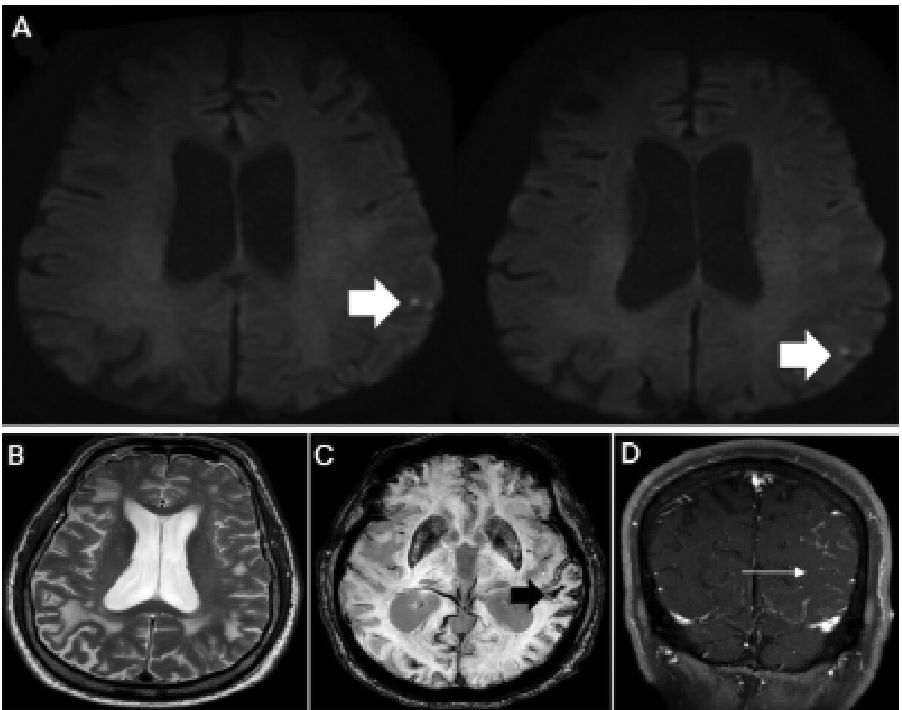
  • A: MRIb axial DWI: AIS in the L temporoparietal[…] region
  • B: MRIb axial T2W: hyperintensities of the white[…] matter advanced for age (65yo)
  • C: MRIb axial SWI: diffuse hemosiderin deposits of the cortical surface c/w superficial siderosis mostly in the L temporoparietal[…] region
  • D: MRIb coronal T1 postcontrast: shows leptomeningeal enhancement mostly in the L temporoparietal[…] region