General

General

Anatomy · 4 cards

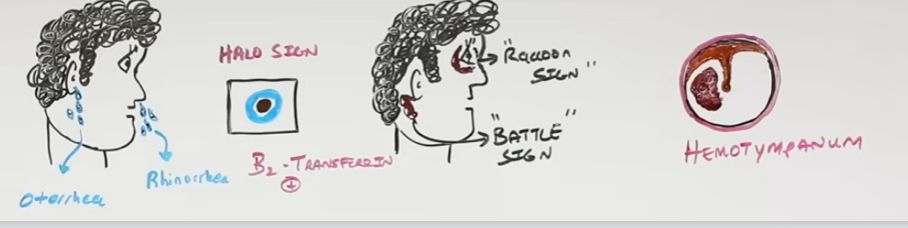
Signs of Trauma
CSF Leak
  • CSF draining from the ear (otorrhea[…]) or nose (rhinorrhea[…]); on gauze, may create a "halo[…]" sign which is a clear ring around central blood on gauze
  • Lab test: β2-transferrin[…](+)
Hematoma
  • "Battle’s[…]" sign = bruising over mastoid c/f basilar skull fracture; "Raccoon's[…]" sign = periorbital bruising
  • Hemotympanum[…] = blood behind TM
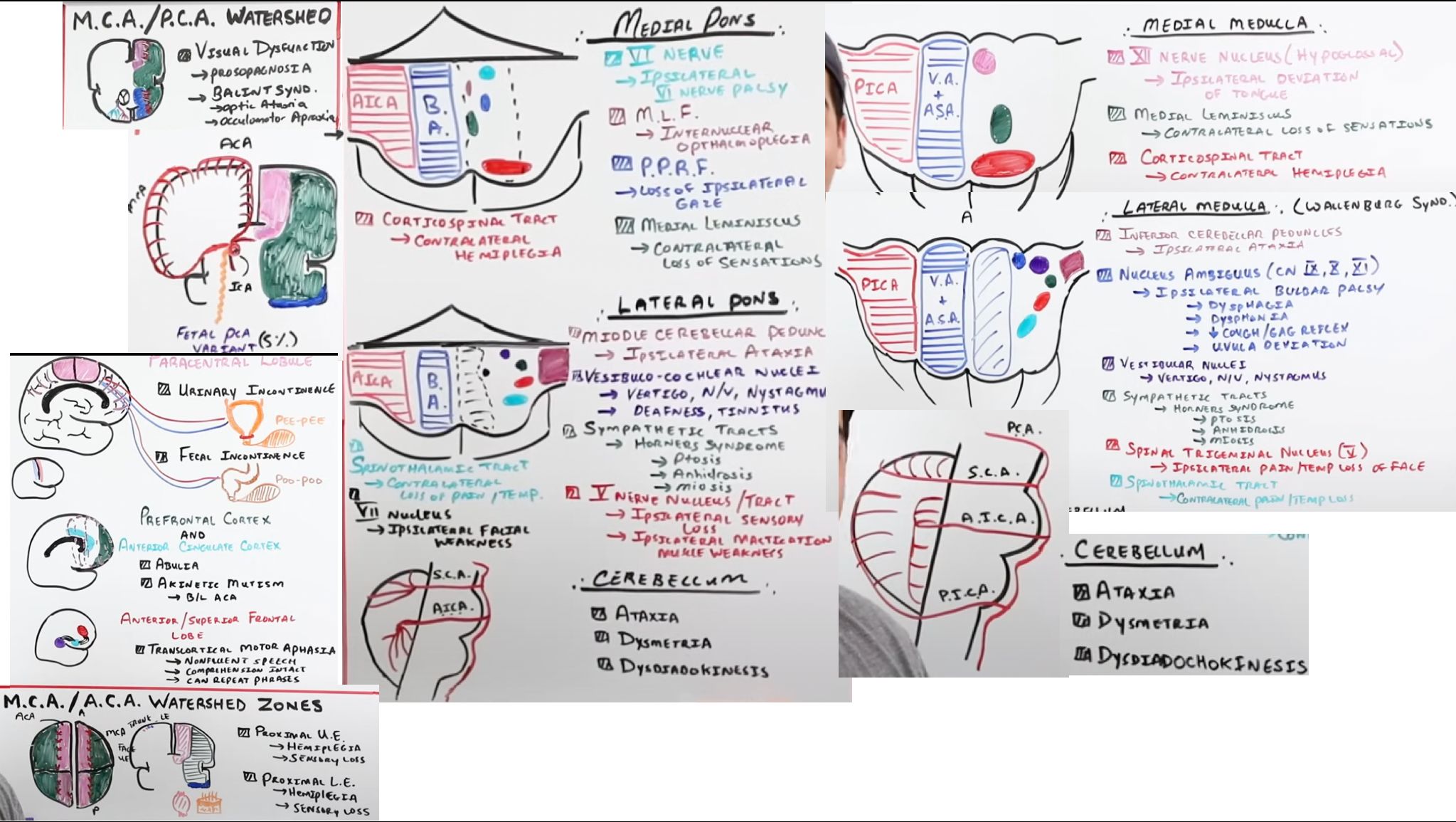
POSTERIOR CIRCULATION STROKE SYNDROMES (Basilar, AICA, Dejerine, Wallenberg, Etc)
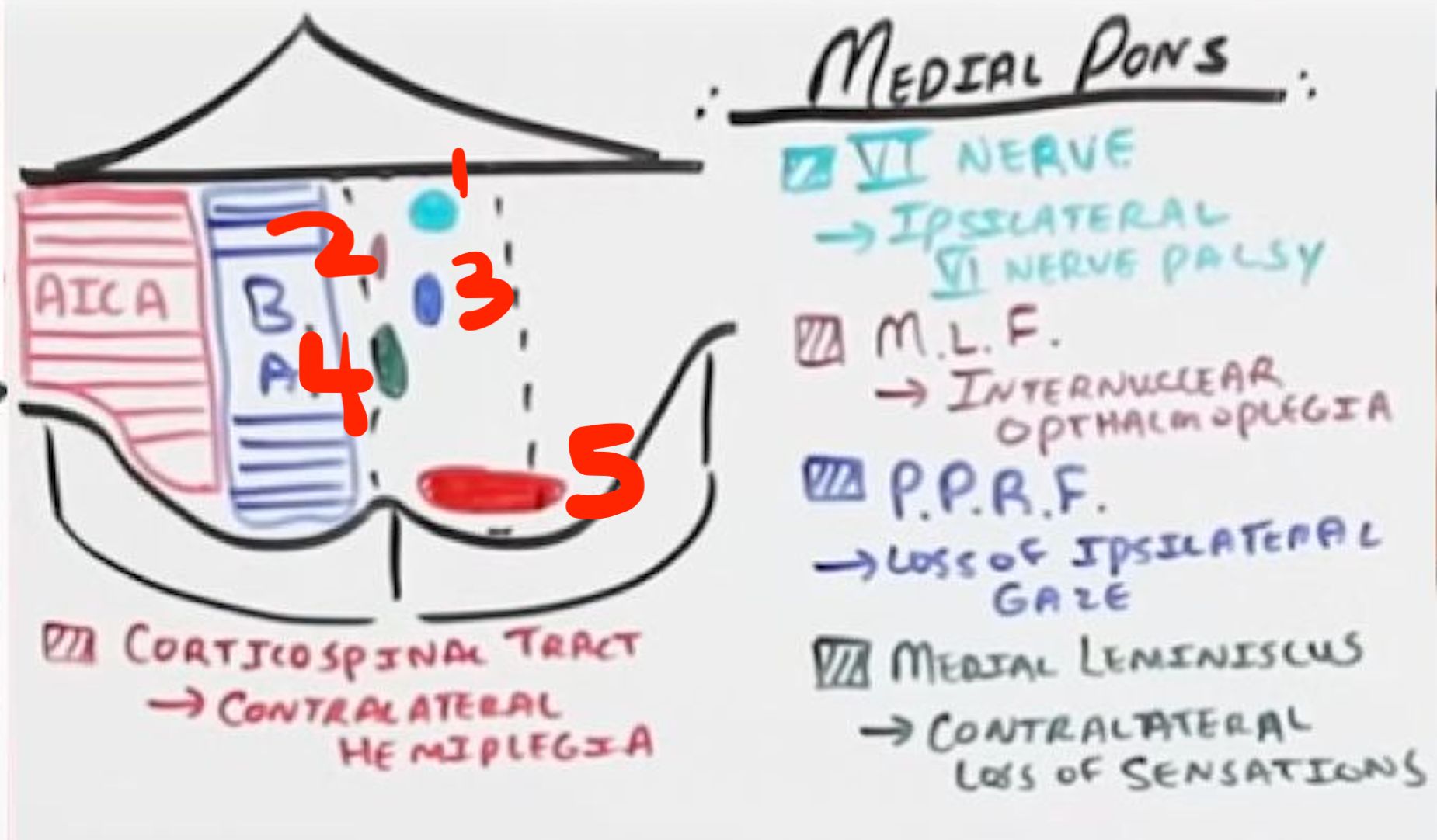
  • Paramedian[…] Branches of the Basilar[…] Artery > @Medial Pons[…]
    1. CN6[…] > sx: ipsi[…]lateral eye cannot abduct
    2. MLF[…] > sx: INO[…]
    3. PPRF[…] > sx: ipsi[…]lateral gaze palsy[…]
    4. Medial Lemniscus[…] > sx: contra[…]lateral loss of vib/prop/discrim touch[…]
    5. CST[…] > sx: contra[…]lateral hemiparesis[…]
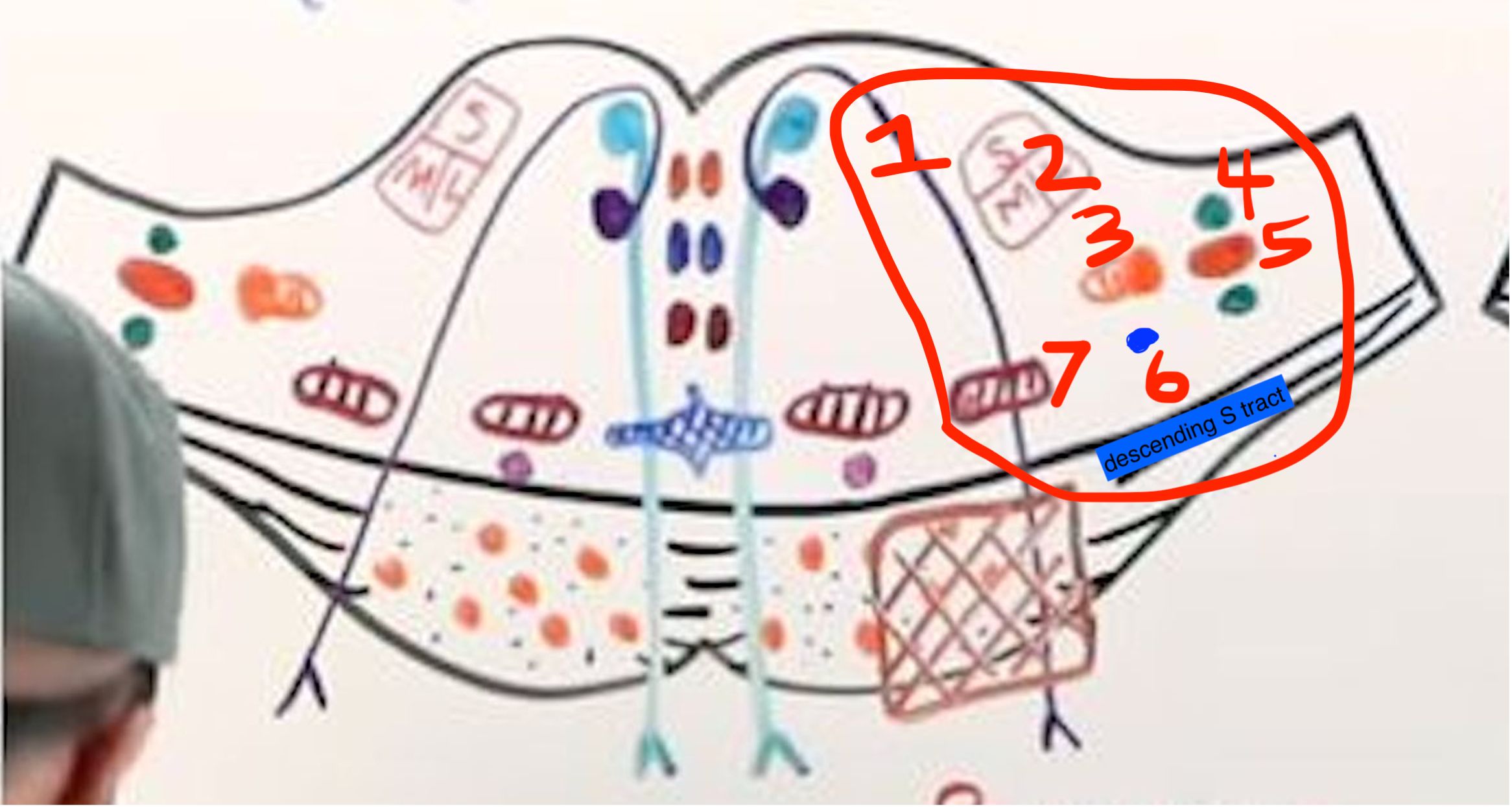
  • AICA[…] > Lateral Pons[…]
    1. CN7[…] > sx: ipsi[…]lateral facial weakness
    2. CN8 Vestibular (S/M/L) Nuclei[…] > sx: n/v/vertigo/nystagmus[…] 
    3. CN5 Spinal Nuclei/Tract[…] > sx: ipsi[…]lateral facial sensory loss + muscle of mastication weakness if principal/motor nuclei affected
    4. CN 8 Cochlear (Ventral/Dorsal) Nuclei[…] > sx: deafness/tinnitus[…]
    5. Middle Cerebellar Peduncle[…]  > sx: ipsi[…]lateral ataxia[…] because the pons can't send info to the cerebellum from the spinocerebellar tract inputs
    6. S tract[…] fibers > sx: Horner[…] Syndrome 
    7. Spinal Lemniscus (STT)[…] > sx: contra[…]lateral loss of pain/T
  • SCA[…] 
    1. Cerebellum > sx: ataxia/dysmetria/dysdiadochokinesia[…]
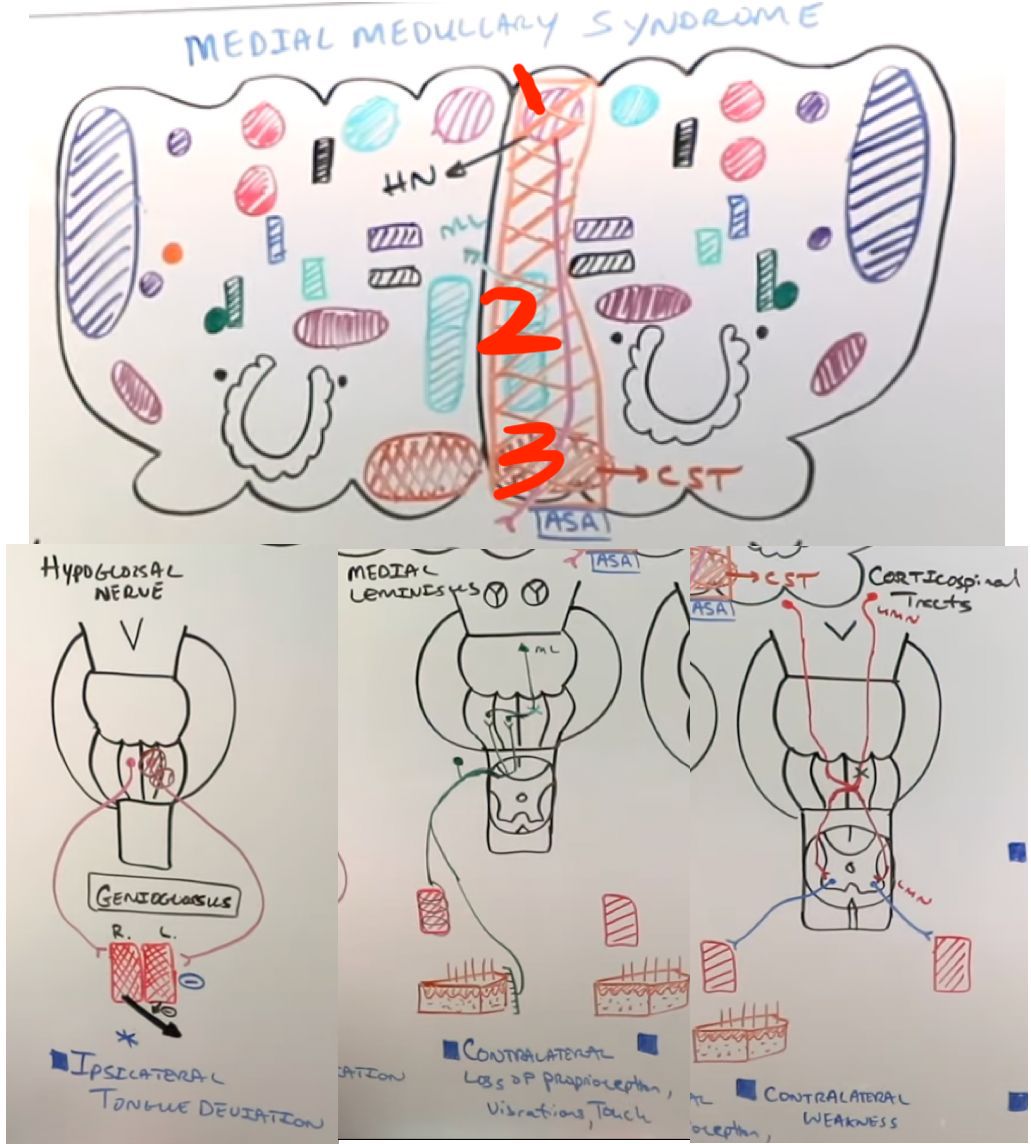
  • Vertebral[…] Artery + Anterior Spinal[…] Artery > Medial Medulla
    1. CN12[…] > sx: ipsi[…]lateral tongue[…] deviation
    2. Medial Lemniscus[…] > sx: contra[…]lateral loss of vib/prop/discrim touch
    3. CST[…] > sx: contra[…]lateral hemiparesis
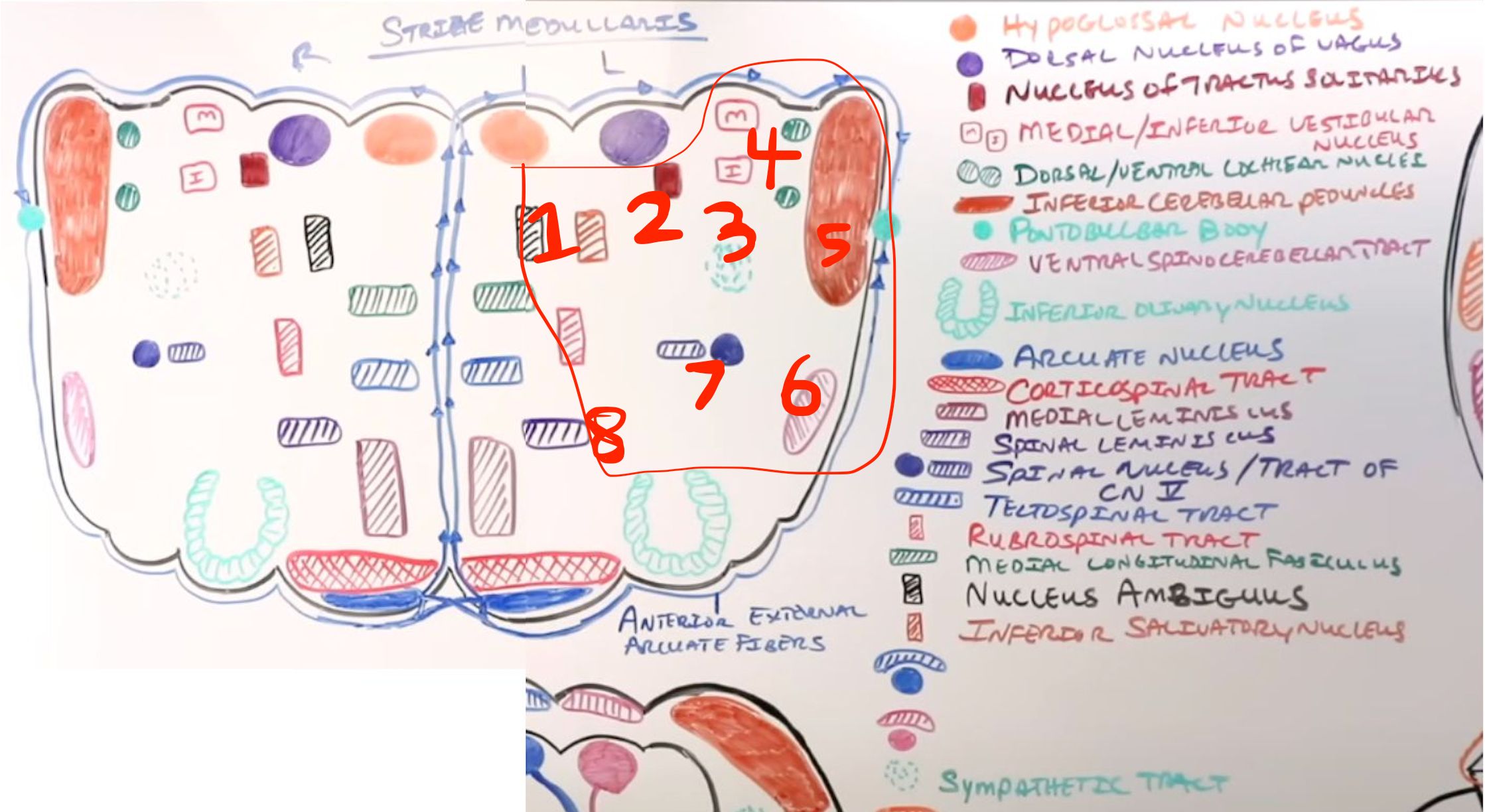
  • PICA[…]Lateral Medulla[…]
    1. nucleus ambiguus[…] for CN 9-11 causing dysphonia/dysphagia/dec cough/gag 
    2. nucleus tractus solitarius[…] for similar functions to above
    3. S tracts[…]Horner's[…] Syndrome
    4. CN8 M/I Vestibular Nuclei + Dorsal/Ventral Cochlear Nuclei[…] > n/v/vertigo/nystagmus
    5. inferior cerebellar peduncle[…] > sx: ipsi[…]lateral ataxia
    6. Spinocerebellar Tract[…] > sx: ipsilateral ataxia also
    7. Spinal Trigeminal Nucleus/Tract[…]ipsi[…]lateral pain/T face
    8. Spinal Lemniscus (STT)[…]contra[…]lateral pain/T


Midbrain Stroke Syndromes  
  • Blood Flow and Arterial Territories
    • PCA[…] to tectum[…], ~75% of anterior tegmentum[…] - most lesions affect this distribution
    • Pcomm[…] to ~25% of anterior tegmentum[…]
    • SCA[…] to midline portion
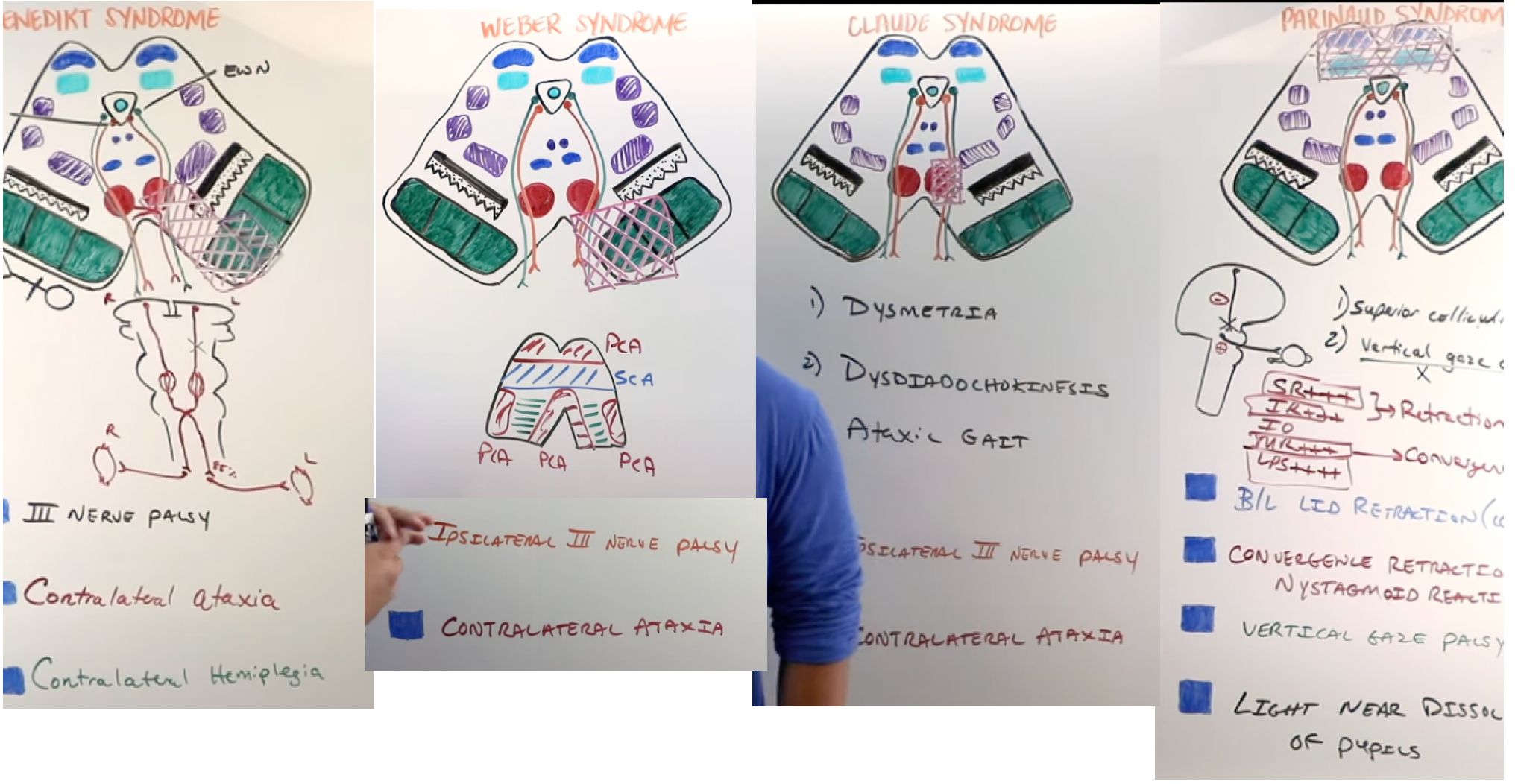
  • Benedikt[…] Syndrome
    • @CN3[…] & EW[…] Nuclei > sx: ipsilateral Down/Out eye, Fixed/Dilated pupil, +Ptosis[…]
    • @Red Nucleus[…] & Ventral Tegmental Decussation[…] > sx: contralateral ataxia[…]
      • pathway: cerebellar hemisphere > contralateral red nucleus > thalamus > cortex
    • @Crus Cerebri (Frontopontine / CST / CBT) Components[…] > sx: contralateral hemiparesis[…]
      • pathway: medial (descending FP), middle (CST/CBT more of head/upper trunk) > decussates at medullary pyramid
    • @Little of Substantia Nigra[…] > sx: athetosis[…] or mild tremors[…] up to more moderate sx like chorea[…]
  • Weber[…] Syndrome
    • @CN3[…] & EW[…] Nuclei > sx: ipsilateral Down/Out eye, Fixed/Dilated pupil, +Ptosis[…]
    • @Crus Cerebri (Frontopontine / CST / CBT) Components[…] > sx: contralateral hemiparesis (face, arm, trunk)[…]
  • Claude[…] Syndrome
    • @CN3[…] & EW[…] Nuclei > sx: ipsilateral Down/Out eye, Fixed/Dilated pupil, +Ptosis[…]
    • @Red Nucleus[…] & Ventral Tegmental Decussation[…] > sx: contralateral ataxia[…]
  • Parinaud[…] Syndrome (ex: pinealoma)
    • @tectum[…] at level of @superior colliculi[…] and @rostral interstitial nucleus of Cahal (vertical gaze center)[…] > sx pathway: cortex > sends inhibitory(-) fibers down to gaze center > out to eyeball; loss of inhibition = excess (+)stimulation of CN3
      • BL eyelid retraction[…] aka "Collier's[…]" Sign
        • due to excess stimulation ++++ of LPS[…] muscle
      • Convergence-Retraction Nystagmoid[…] Reaction
        • due to excess stimulation of SR, IR muscles which pull the eyelid back + MR contracting which causes the convergence
      • Vertical Gaze[…] Palsy
    • @pretectal nucleus[…] > sx: "Light-Near Dissociation[…]" of pupil aka "Argyll-Robertson[…]" Pupil > meaning shine light > pupils don't constrict; bring finger close to accommodate, pupils constrict[describe what this is]
PONS Stroke Syndromes  
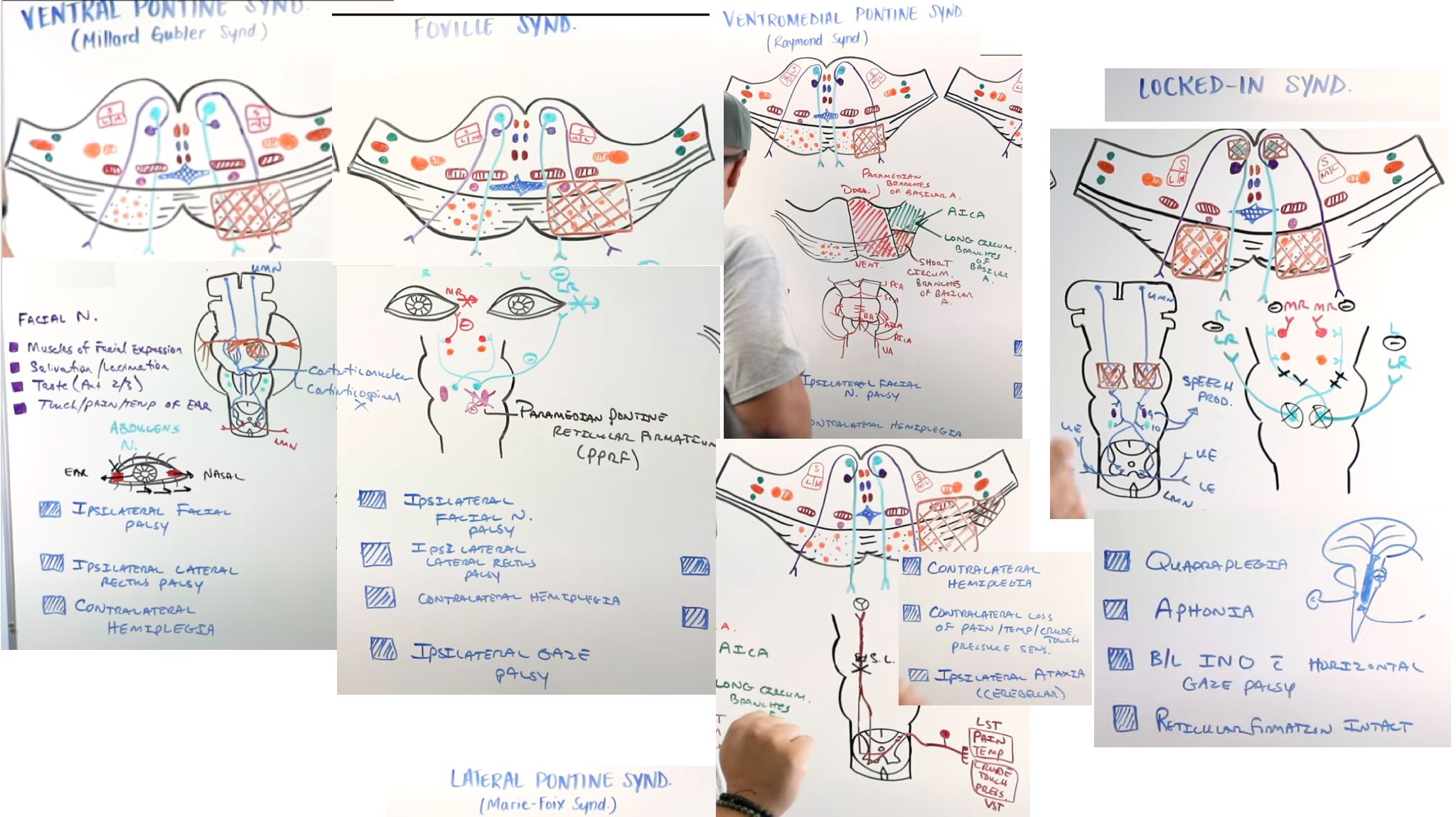
  • Arterial Supply
    • occlusion of paramedian branches, basilar artery[…] will cause damage to medial[…] pons
    • occlusion of short circumferential branches, basilar artery[…] will cause damage to ventral, lateral[…] pons
    • occlusion of long circumferential branches, basilar artery[…] and AICA[…] will cause damage to dorsal, lateral[…] pons
  • Millard-Gubler[…] Syndrome aka Ventral[…] Pontine Syndrome
    • @CN7[…] > sx: ipsilateral CN7 palsy[…] [(facial[…] droop, loss of salivation[…]/lacrimation[…]/taste[…] to ant 2/3[…] tongue/touch pain T from ear[…]]
    • @CN6[…] > sx: ipsilateral CN6 palsy[…] [no LR[…] > medial[…] gaze deviation]
    • @Pontine Nuclei[…] > sx: contralateral hemiparesis[…]
      • pathway: loss of descending cortico-ponto-cerebellar + cortico-pontine (CST, CBT) tracts > primarily takes out CST fibers
  • Foville[…] Syndrome
    • @CN7[…] > sx: ipsilateral CN7 palsy[…] [(facial[…] droop, loss of salivation[…]/lacrimation[…]/taste[…] to ant 2/3[…] tongue/touch pain T from ear[…]]
    • @CN6[…] > sx: ipsilateral CN6 palsy[…] [no LR[…] > medial[…] gaze deviation]
    • @Pontine Nuclei[…] > sx: contralateral hemiparesis[…]
      • pathway: loss of descending cortico-ponto-cerebellar + cortico-pontine (CST, CBT) tracts > primarily takes out CST fibers
    • @PPRF[…] > sx: can't abduct[…] ipsilateral eye; can't adduct[…] contralateral eye > ipsi[…]lateral gaze palsy
  • Raymond[…] Syndrome aka Ventromedial[…] Pontine Syndrome
    • @CN7[…] > sx: ipsilateral CN7 palsy[…] [(facial[…] droop, loss of salivation[…]/lacrimation[…]/taste[…] to ant 2/3[…] tongue/touch pain T from ear[…]]
    • @Pontine Nuclei[…] > sx: contralateral hemiparesis[…]
  • Marie-Foix[…] Syndrome aka Lateral[…] Pontine Syndrome
    • @Pontine Nuclei[…] > sx: contralateral hemiparesis[…]
    • @Spinal Lemniscus[…] > sx: contralateral pain/T loss[…] from lateral[…] STT + crude touch/pressure[…] from ventral[…] STT
    • @Middle Cerebellar Peduncle[…] > sx: ipsilateral ataxia[…]
  • Locked In[…] Syndrome
    • @BL CST[…] > sx: quadriplegia[…]
    • @BL CN 9/10[…] > sx: aphonia (can't speak)[…]
    • @BL CN6[…] > sx: loss of CN6[…] + CN3[…] + INO[condition?] bilaterally > overall leading to BL INO + Horizontal[…] Gaze Palsy
    • The Reticular Formation[…] remains intact so consciousness/wakefulness is intact
      • touch, visual, auditory stim > goes here > sends to cortex to arouse/awake you